Start early, practice 10 to 15 minutes a day for as long as you can, learn all nine question types with an explanation after every question, give extra time to the weakest battery, and take full practice tests: at least two, and more is better.
Why practice helps on the CogAT®
The Cognitive Abilities Test (CogAT®) asks a 2nd grader to work through nine kinds of puzzles that look nothing like ordinary schoolwork. A child seeing a Paper Folding or Number Puzzles question for the first time spends time working out what is being asked. A child who has practiced starts reasoning right away.
Practice teaches what each question type looks like, ways to approach and think through it, and how to keep going through a long test. Reasoning skills build like a muscle, a little at a time, which is why months of short practice help more than a few long sessions. The publisher itself provides practice activities for schools, so every child understands the directions and question types before testing.
Sample question
Try a CogAT® practice question
Look at how the paper is folded and punched. Choose what the paper will look like when it is opened.
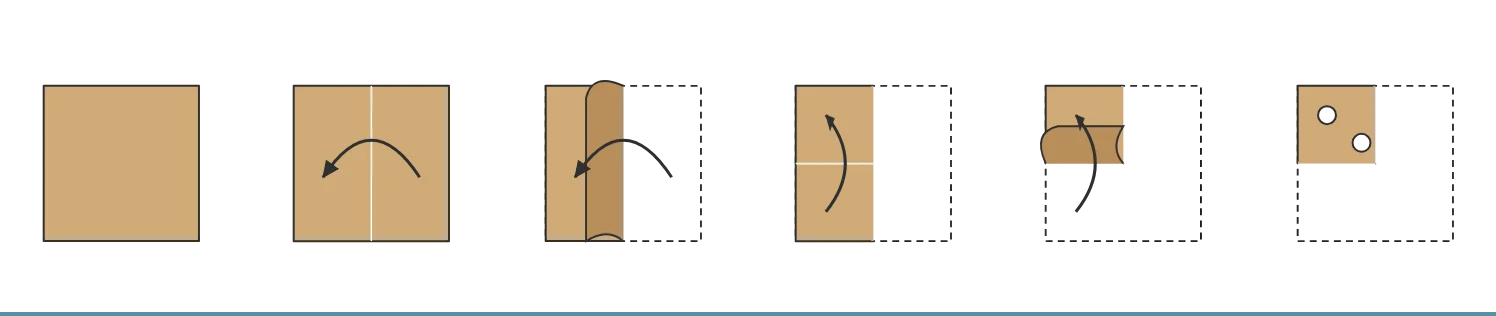
A real GateBuddy practice question.
Choose one of the four answers.
Unfold in reverse order. The punched circle is reflected across each fold line, so the opened paper shows the matching circle holes.
Try 10 more questions free
See how easy practice can be for your child.
- Short practice sets made for kids
- Read aloud, so they can work on their own
- All nine CogAT® question types
Free parent account. No credit card.
How to prepare effectively for the CogAT®
- Learn the format first, and talk through the rule after every question. Ask your child what stayed the same and what changed, so the idea carries over to the next question. GateBuddy shows an explanation after every answer, and your child can tap Listen to hear the question and the explanation read aloud.
- Practice 10 to 15 minutes a day, for as long as you can. Reasoning skills build like a muscle, a little at a time. A few weeks of practice helps, but months of short, steady sessions help more, so start as early as you can. GateBuddy’s short practice sets fit on a school night.
- Spend extra time on the weakest battery. Most children find one of the three parts harder than the others. GateBuddy’s practice adapts to your child’s answers and keeps verbal, quantitative, and nonverbal progress side by side, so you can see where to focus.
- Take full practice tests: at least two, and more is better. A full test teaches your child to keep going through nine subtests over more than one sitting, the way test day works. Every GateBuddy plan includes eight complete practice tests for the 2nd grade CogAT®, with progress saved between sections. Take several along the way, and save the last two for the final few weeks as a dress rehearsal.
A simple week of practice
Rotate the three batteries so your child sees every question type often:
- Monday: Verbal (Picture Analogies, Sentence Completion, Picture Classification).
- Tuesday: Quantitative (Number Analogies, Number Puzzles, Number Series).
- Wednesday: Nonverbal (Figure Matrices, Paper Folding, Figure Classification).
- Thursday: the battery that felt hardest this week.
- Friday: a mixed set, then talk through any misses together.
Keep each day to 10 to 15 minutes, and stop a session early if your child is tired. Every few weeks, add a full practice test on a weekend.
Everyday activities that build each battery
- Verbal: play “how are these alike?” with everyday objects, and talk about why things belong together.
- Quantitative: count, compare, and share things out at home, and make and continue simple patterns with beads, blocks, or coins.
- Nonverbal: fold and cut paper to see what happens, build with blocks, and do jigsaw and shape puzzles.
Timeline: months out to test week
- Now: find your district’s testing window with the district lookup, and learn the nine question types.
- Most of the time before the test: daily 10 to 15 minute practice, with full practice tests along the way.
- The final few weeks: the last two full practice tests as a dress rehearsal, and extra time on the weakest battery.
- Test week: keep the routine short and familiar, get good sleep, and remind your child that the teacher reads the directions and it is fine not to know every answer.
GateBuddy’s free questions cover all nine question types, with an explanation after every answer.
Try 10 CogAT® questions freeOur guides to the nine CogAT® question types and 2nd grade CogAT® practice go deeper on each part.
Districts that give the CogAT® to 2nd graders
- Deer Valley USD, AZ
- Scottsdale USD, AZ
- Long Beach USD, CA
- San Diego Unified, CA
- San Ramon Valley USD, CA
- Jefferson County (Jeffco), CO
- Baltimore County PS, MD
- Montgomery County PS, MD
- Wake County PSS, NC
- Centerville City Schools, OH
- Olentangy Local SD, OH
- South Carolina (statewide), SC
- Prosper ISD, TX
- Loudoun County PS, VA
- Bellevue SD, WA
Why GateBuddy
Practice all nine CogAT® Level 8 question types in one guided program.
GateBuddy combines short adaptive practice, clear explanations after every answer, and eight complete untimed practice tests. It keeps Verbal, Quantitative, and Nonverbal progress together while showing what to practice next.
Start with 10 free CogAT® questions.
Try every Level 8 question type, then get one smart follow-up based on the answers.
Frequently asked questions
When should we start preparing for the CogAT®?
As early as you can. A few weeks of practice helps, but months of short daily practice help more. Find your district’s testing window, then practice 10 to 15 minutes a day until test day.
How many CogAT® practice tests should my child take?
At least two full practice tests, and more is better. Take several along the way, and save the last two for the final few weeks. Every GateBuddy plan includes eight complete practice tests for the 2nd grade CogAT®.
How long should each practice session be?
Ten to fifteen minutes most days. Short sessions are easy to keep up for months, and stopping early on a tired day is fine.
What should we focus on first?
Learn all nine question types first, then spend extra time on the battery that feels hardest. Paper Folding and Number Puzzles are often the least familiar.
Does GateBuddy help with CogAT® preparation?
Yes. GateBuddy offers 2nd grade CogAT® practice with all nine question types, adaptive practice, an explanation after every answer that your child can listen to, and eight complete practice tests. You can try 10 questions free.