EEE stands for Extended Educational Experiences, Columbia Public Schools’ (CPS’s) gifted program. Getting into EEE takes two separate tests, not one, which surprises families who expect a single test and a single result.
This guide is for Columbia, Missouri parents who want to understand what EEE gives a child, how both steps work, and how to prepare for the part that uses visual reasoning: the NNAT3.
What EEE gives your child in Columbia Public Schools
CPS says more than 600 elementary students get gifted services each year. Here is what being identified means:
- One full day a week at the Center for Gifted Education (grades 1 to 5). Each elementary school has an assigned weekday. Most students ride a bus from their own school to the Center, in the historic Eugene Field school building, for a full day of gifted classes.
- A homeroom with children their own age. Homeroom groups stay the same all year and focus on the social and emotional needs of gifted children.
- In-depth “major” courses. Each trimester, students choose courses that mix subjects, with a focus on math, literature, science, art, and history.
- A Learning Fair each trimester. Families are invited to see a final project, presentation, or performance.
- Teachers trained for gifted learners. CPS says all EEE teachers hold K-12 gifted certification.
- Middle School EEE (grades 6 to 8). Students take EEE classes every other day, alternating with PE (physical education), in small classes of 12 to 20 focused on research, creative and critical thinking, and social and emotional needs.
CPS says the decision to join EEE should be based on each child’s needs, not treated as a reward for good grades. And because EEE continues into middle school, identification still matters after 5th grade. The middle school page does not explain how students enter that program, so ask.
Sample question
Try an NNAT® practice question
Use the completed example to picture how the shapes outside the frame fold inward.
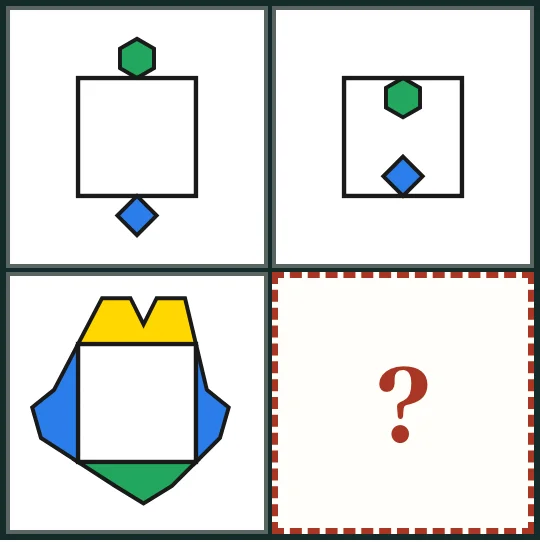
A real GateBuddy practice question.
Choose one of the five answers.
The yellow, blue, green, blue panels fold inward across their full hinge edges. They fit together around the white star-shaped space in the center. The hinge pattern sits a little below or right of center.
Try 10 more questions free
See how easy practice can be for your child.
- Short practice sets made for kids
- Read aloud, so they can work on their own
- Extra practice where they miss
Free parent account. No credit card.
Practice preview
Let your child see the format before test day.
GateBuddy introduces the visual reasoning formats used on the NNAT® through short, age-appropriate practice with clear explanations.
- Built around the four NNAT® question types
- An explanation after every answer: what changed and what stayed the same
- Short adaptive sets plus full, timed practice tests
- A live view so parents can follow along


Real GateBuddy practice questions, one of each NNAT® question type.
How Columbia’s two-step identification works
- Step 1: NNAT3 screening (everyone in kindergarten and 2nd grade). In March, every kindergartner and 2nd grader takes the NNAT3 on a computer at their own school, usually given by the school counselor. It takes about 30 minutes. Students new to CPS who are not in a screening grade take it too.
- Step 2: WISC-V (only students who score high enough). CPS’s identification page says a percentile rank in the high 80s or 90s on the NNAT3 makes a student eligible for further testing. The Center for Gifted Education’s site says the 86th percentile and up. Families sign a permission form, and a trained examiner gives the WISC-V one-on-one, usually at the child’s school during the school day. It takes about an hour.
The WISC-V, not the NNAT3, decides eligibility. The two district pages describe the rule differently:
- CPS identification page: a base score of 120 on the WISC-V General Ability Index (GAI), with some flexibility for a child whose verbal and nonverbal scores are very different.
- Center for Gifted Education site: scoring in the top 5 percent, following Missouri guidelines, using both ability (IQ) scores and achievement scores from the past two years: i-Ready reading and math, and MAP (Missouri Assessment Program) reading, math, and science.
The NNAT3 reports a Naglieri Ability Index (NAI), where 100 is average and 160 is the highest possible, and a percentile rank from 1 to 99. The Step 2 cutoff uses the percentile rank.
| Test basics | What Columbia parents should know |
|---|---|
| Step 1 test | NNAT3, every kindergartner and 2nd grader, in March |
| Moving to Step 2 | Percentile rank in the high 80s or above (the Center’s site says 86th and up) |
| Step 2 test | WISC-V, one-on-one, about an hour, usually at your child’s school |
| Qualifying rule | GAI base score of 120 (identification page) or top 5 percent using ability and achievement data (Center site) |
| Spring cycle | March through June; Step 2 notifications by July (identification page) or by April 14 (Center site) |
| Fall cycle | September through November for new students and referrals; notifications by December |
| Retesting | 6 months after the last NNAT, 12 months after the last WISC; closed after a third evaluation |
| Services begin | August, per the Center’s site |
The NNAT® may look nothing like ordinary classwork. Give your child a first look at pattern completion, analogies, serial reasoning, and spatial visualization.
Start free practiceAt the NNAT3’s kindergarten and 2nd grade levels, students see Pattern Completion, Reasoning by Analogy, Serial Reasoning, and Spatial Visualization questions: find what changes, what stays the same, and which answer follows the same visual rule. For a parent-friendly walkthrough of those four formats, see our guide to the four NNAT® question types.
Why both steps matter in Columbia
Every kindergartner and 2nd grader takes the NNAT3, so it is easy to treat it as the real test. But a strong NNAT3 score only earns a WISC-V appointment. The WISC-V result decides whether a child enters EEE.
Still, a child who does not clear Step 1 never reaches Step 2, so the NNAT3 is the gate every child has to pass. It is also the only part that uses an unfamiliar, puzzle-like format, which is why getting comfortable with it helps.
A child who is not identified has more chances. Families or school staff can ask the school counselor or the Gifted Center for a re-evaluation once at least 6 months have passed since the last NNAT screening and at least 12 months since the last WISC test. After a third evaluation, testing for elementary gifted services is closed.
Curious how your child would do? Find out with no pressure.
Try 10 questions free nowQuestions Columbia parents should ask
- What date in March will my child’s class take the NNAT3?
- What NNAT3 percentile moves a child to Step 2 this year?
- When will we hear whether my child moves to Step 2, and when would the WISC-V be scheduled?
- Which qualifying rule applies this year: the 120 GAI base score, or the top 5 percent with achievement data?
- When will we get final results, and when would EEE services start?
- Which weekday does our school attend the Gifted Center, and how does the bus work?
- How many of my child’s three evaluations have been used, and when is the next one possible?
Our broader questions to ask your school guide can help you turn those into one clear conversation with the office or program contact.
How to prepare effectively for the NNAT
- Start with the format. Show your child each of the four NNAT question types in short sessions, and talk through the rule after every question. A good explanation names the rule, so your child can use it on the next question. GateBuddy shows an explanation after every question that names the rule, and it can read instructions and explanations out loud, which helps a child who is still building reading skills or simply learns better by hearing it.
- Practice 10 to 15 minutes a day, for as long as you can. Reasoning skills build like a muscle, a little at a time. A few weeks of practice helps, but months of short, steady sessions build much more. Starting by the fall gives plenty of time before March.
- Spend extra time on the weakest type. Most children find one or two question types harder. Focus there once the basics feel familiar. GateBuddy’s practice sets do this for you: each set of five leans toward the question types your child has seen least and adjusts how hard the next questions are based on recent answers. You can also pick one question type and a level (easy, medium, or hard) to work on a weak spot.
- Take full, timed practice tests: at least two, and more is better. A full test is where your child learns pacing and how to work alone against a clock, the way test day works. Every GateBuddy plan includes eight full, timed NNAT® practice tests, so your child can take several along the way and still save the last two for the final few weeks as a dress rehearsal. While your child works on their own, GateBuddy’s Live View lets you follow along from your own phone: how many questions they have answered, the answer they just picked, and how many they have right so far. Your child gets the independence of test day, and you still see everything.
Our guide to how to prepare for the NNAT® goes deeper on each step.
Why GateBuddy
Practice that feels like test day, built by parents who needed it.
GateBuddy started with parents preparing their own kids for the NNAT® and finding mostly printable packets and answer keys. So they built what they wished they had: short daily practice that adapts, full timed tests that feel like test day, and a way to see progress without hovering.
What your child gets:
- Five questions at a time, picked for your childEach short set adapts to your child’s recent answers and to the question types they have seen least. Ten to fifteen minutes fits on a school night.
- Explanations that teach the ruleAfter every question, your child sees what changed and what stayed the same, so the idea carries over to the next one.
- Read aloud when it helpsInstructions and explanations can be read out loud, so a child still learning to read can focus on the reasoning.
- Full, timed practice testsEight full tests with a visible timer, a question list to skip and come back, and pause and resume for real life. Take several along the way and save the last two as dress rehearsals.
- Live view for parentsFollow a practice test from your own phone: questions answered, the answer just picked, and how many are right so far. Your child works on their own, like test day.
- Focused practice when you want itPick one of the four NNAT® question types and a level (easy, medium, or hard) to work on a weak spot.
GateBuddy vs printable packets and workbooks
| Feature | Packets and workbooks | GateBuddy |
|---|---|---|
| Choosing what to practice next | The same pages for every child | Adapts to your child’s answers |
| When an answer is wrong | A letter in the answer key | An explanation of the rule |
| Timed practice | You time it yourself | Built-in timer, skip and return, pause |
| Watching progress | Grade it by hand afterward | Live view while they work |
| Format | Paper | On screen, the way many districts now give it |
Start with 10 free questions.
See how your child handles NNAT® practice questions in about ten minutes, then decide.
Frequently asked questions
What test does Columbia Public Schools use for gifted screening?
Two tests, in two steps. Step 1 is the NNAT3, given to every kindergartner and 2nd grader in March. Step 2 is the WISC-V, a one-on-one test for students who score high enough on the NNAT3.
What NNAT3 score moves a Columbia student to Step 2?
CPS’s identification page says a percentile rank in the high 80s or 90s makes a student eligible for further testing. The Center for Gifted Education’s own site says the 86th percentile and up. Ask the Center which number applies this year.
What score qualifies a Columbia student for EEE?
CPS’s identification page says entry into EEE requires a base score of 120 on the WISC-V General Ability Index. The Center for Gifted Education’s site describes the rule as scoring in the top 5 percent, using both ability and achievement data. The two district pages do not match, so confirm with the Center.
When is gifted screening in Columbia Public Schools?
Kindergarten and 2nd grade screening happens in March. CPS’s identification page says the spring cycle runs March through June, with Step 2 notifications by July. A fall cycle, September through November with notifications by December, is for new students, students who missed screening, and qualifying referrals.
What does EEE give my child in Columbia?
Identified students in grades 1 to 5 spend one full day a week at the Center for Gifted Education, most of them bused from their school. They take in-depth courses in math, literature, science, art, and history, taught by teachers with gifted certification. A Middle School EEE program continues in grades 6 to 8.
Can a Columbia student be tested again?
Yes. A family or school can request re-evaluation if at least 6 months have passed since the last NNAT screening and at least 12 months since the last WISC test. After a third evaluation, elementary testing is closed.
- Columbia Public Schools: Gifted Identification Process
- Columbia Public Schools Center for Gifted Education: Identification Process
- Columbia Public Schools: Gifted Education Services
- Columbia Public Schools: Middle School EEE Program
- GateBuddy: What is the NNAT®?
GateBuddy compiled this guide from its own research of publicly available information and is not affiliated with Columbia Public Schools. The guide may contain errors or be out of date. Please confirm all details with your school or district.