Bright students miss Gifted and Talented Education (GATE) opportunities every year, not because they lack ability, but because the format catches them cold. Parents often assume a strong reader or a child who flies through math homework will naturally shine on the district screening test. Then test day arrives, and the child is staring at abstract visual puzzles on a screen, under time pressure, with no familiar schoolwork to anchor them.
That gap between ability and readiness is what many families miss. GATE screening is often less about whether a child is capable of advanced learning and more about whether they can show that capability in a format they have never really practiced before.
Why the early screening window matters
The exact screening grade depends on the district. Some schools test universally in second grade. Others screen in third grade, open referrals in grades 2 through 5, or give students another chance in fourth grade. Across districts, families often first encounter this process somewhere in the grade 2 to grade 4 range.
The National Association for Gifted Children notes that early identification improves the likelihood that a child’s gifts are developed into talents, and that no single test at one point in time should determine a gifted identification on its own. That is a useful frame for a first screening: it is one data point in an ongoing process, not a final verdict.
One reason this window carries more weight than families expect: in many districts, the students who enter honors tracking, cluster grouping, or accelerated coursework later on are drawn heavily from the group already identified as gifted. That is not an absolute rule. A student who was not identified in 2nd grade is not locked out, and most districts publish a formal appeal or re-referral process for exactly this reason. But getting in later is often a longer road: a written appeal, a new round of testing or teacher evaluation, sometimes a monitoring period to build a case, and, at the classroom level, a limited number of seats that gifted-identified students have often already filled by the time a later appeal is reviewed. None of that makes it impossible. It does make it slower and less certain than qualifying the first time.
This matters beyond elementary school. Honors and Advanced Placement (AP) coursework is not just about the classroom experience: the National Association for College Admission Counseling’s own research finds that grades in challenging, college-preparatory courses are what selective colleges weigh most heavily in admission decisions, ahead of test scores or class rank. A track a family enters or misses in elementary school can still be shaping course options, and college applications, years later.
What stays consistent is the bigger pattern: early gifted identification is not simply about joining a temporary pull-out group. In plenty of districts, it affects what enrichment, cluster placement, honors pathways, or advanced opportunities become more available later. That is why families benefit from understanding the process before their district’s testing year arrives.
See the real question format in about ten minutes.
Try 10 questions freeSample question
Try an NNAT® practice question
Use the completed example to picture how the shapes outside the frame fold inward.
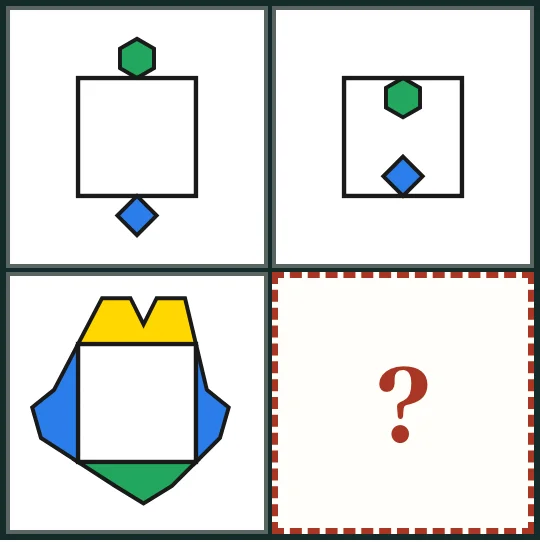
A real GateBuddy practice question.
Choose one of the five answers.
The yellow, blue, green, blue panels fold inward across their full hinge edges. They fit together around the white star-shaped space in the center. The hinge pattern sits a little below or right of center.
Try 10 more questions free
See how easy practice can be for your child.
- Short practice sets made for kids
- Read aloud, so they can work on their own
- Extra practice where they miss
Free parent account. No credit card.
The unfamiliar landscape of the NNAT®
One major reason strong students stumble is that the assessment does not look like normal schoolwork. Many districts rely on the Naglieri Nonverbal Ability Test (NNAT®) for this age range. It does not ask for memorized facts, vocabulary recall, or worksheet fluency. Instead, it asks a child to reason through abstract visual logic.
Pearson, the NNAT®’s publisher, describes it as a measure of nonverbal reasoning and problem-solving ability that does not require reading, writing, or prior content knowledge, which is exactly why it can surprise a strong student who has only ever been evaluated on schoolwork.
A child may suddenly be expected to interpret pattern continuations, visual analogies, spatial folds, and multi-step matrix rules made entirely of shapes and colors. On top of that, they are doing it on a screen with a timer running. Even children who are academically advanced can freeze when the format itself feels strange.
What children actually see
Four question types, each with its own logic.
These are real GateBuddy bank examples, one from each NNAT® format, so families can see the kind of visual reasoning the test actually asks for.

Pattern Completion
Complete the windowFollow lines, shapes, and colors through a missing section of one continuous design.

Reasoning by Analogy
Apply the changeDiscover how one picture changes, then use the same relationship again.

Serial Reasoning
Finish both patternsRead changes across rows and columns to determine the missing picture.

Spatial Visualization
Picture the resultCombine, rotate, or fold visual information in your mind to find the matching answer.
This is one reason families benefit from reading a clear overview of what the NNAT® actually measures before deciding how to prepare.
Why traditional prep often falls short
When parents realize the stakes, the instinct is often to buy a thick workbook. That reaction makes sense, but it usually solves the wrong problem. Paper packets can offer exposure, yet they do not mirror the real testing medium. A child preparing on static pages is not learning how to navigate a screen-based task, manage a visible clock, or recover after choosing the wrong answer.
Just as importantly, a workbook answer key rarely teaches the rule behind a mistake. A child sees that the correct answer was C, but not why C followed the pattern. That difference matters. Preparation is most useful when it teaches a child how to identify what changed, what stayed the same, and how to test a rule before committing to an answer.
Curious how your child would do? Find out with no pressure.
Try 10 questions free nowConfidence comes from familiarity, not cramming
Readiness is built over time. Steady practice makes the format feel recognizable and manageable, and keeping it up for months reinforces it. Children need a chance to learn the mechanics of visual logic, especially how to spot transformations, compare edges, track rotations, and notice invariants inside a pattern.
That kind of familiarity changes the experience of test day. A child who has seen these formats before is more likely to think, “I know how this kind of puzzle works,” instead of, “What am I even looking at?” That shift is not small. It can be the difference between freezing and engaging.
For families thinking through next steps, our guide to preparing effectively for the NNAT® gives a simple way to structure short practice over time.
Bridging the gap with better preparation
Good preparation adapts to the actual test environment. It helps a child practice on screen, understand the rule behind each answer, and revisit the exact skills that caused trouble. It also helps the parent see more than a score, because a score alone does not tell you whether the problem was timing, spatial reasoning, edge matching, or misunderstanding the format.
When practice becomes interactive and responsive, the experience changes. A missed question becomes useful information instead of a dead end. A child starts to recognize that these are puzzles with rules, not random tricks. That is where confidence starts to grow.
Short, adaptive practice your child can finish on a school night.
Start 10 free questionsLevel the playing field with GateBuddy
We built GateBuddy to replace outdated paper packets with a screen-accurate preparation system that reflects how many districts now give the NNAT®. Children can practice visual-reasoning questions in the actual medium, get immediate explanations, and build familiarity across all four major NNAT® formats.
GateBuddy includes 1,000+ original visual-reasoning questions, adaptive practice that targets missed skills, and full-length timed tests that better prepare children for the digital assessment experience. The goal is simple: help your child show what they are capable of when the test day window opens.
Why GateBuddy
Practice that feels like test day, built by parents who needed it.
GateBuddy started with parents preparing their own kids for the NNAT® and finding mostly printable packets and answer keys. So they built what they wished they had: short daily practice that adapts, full timed tests that feel like test day, and a way to see progress without hovering.
What your child gets:
- Five questions at a time, picked for your childEach short set adapts to your child’s recent answers and to the question types they have seen least. Ten to fifteen minutes fits on a school night.
- Explanations that teach the ruleAfter every question, your child sees what changed and what stayed the same, so the idea carries over to the next one.
- Read aloud when it helpsInstructions and explanations can be read out loud, so a child still learning to read can focus on the reasoning.
- Full, timed practice testsEight full tests with a visible timer, a question list to skip and come back, and pause and resume for real life. Take several along the way and save the last two as dress rehearsals.
- Live view for parentsFollow a practice test from your own phone: questions answered, the answer just picked, and how many are right so far. Your child works on their own, like test day.
- Focused practice when you want itPick one of the four NNAT® question types and a level (easy, medium, or hard) to work on a weak spot.
GateBuddy vs printable packets and workbooks
| Feature | Packets and workbooks | GateBuddy |
|---|---|---|
| Choosing what to practice next | The same pages for every child | Adapts to your child’s answers |
| When an answer is wrong | A letter in the answer key | An explanation of the rule |
| Timed practice | You time it yourself | Built-in timer, skip and return, pause |
| Watching progress | Grade it by hand afterward | Live view while they work |
| Format | Paper | On screen, the way many districts now give it |
Start with 10 free questions.
See how your child handles NNAT® practice questions in about ten minutes, then decide.
Frequently asked questions
When do districts usually screen for GATE?
It depends on the district. Many families first encounter gifted screening in the early elementary years, often around grades 2 through 4, but local timing and criteria vary and should always be confirmed with the school or district.
Why do bright students struggle with the NNAT®?
The challenge is often the unfamiliar format, not lack of ability. The NNAT® uses abstract visual logic on a screen, under time pressure, which feels very different from normal classroom tasks.
Are workbooks enough for NNAT® preparation?
They can help with exposure, but they do not reproduce the screen-based experience, timing, or immediate rule-based feedback a child gets on a digital assessment.
What kind of practice helps most before the NNAT®?
The most useful practice builds familiarity with the four question types on screen, gives clear explanations after mistakes, and helps a child learn the visual rules before test day.