In Ohio, families are more likely to hear gifted screening or gifted identification than GATE (Gifted and Talented Education). Columbus calls its program Gifted & Talented. The NNAT® (Naglieri Nonverbal Ability Test) is a visual reasoning assessment that uses shapes and patterns instead of reading passages, vocabulary, or math computation.
What Columbus says about gifted identification
Columbus City Schools says students in 2nd grade take the NNAT in November to screen for superior cognitive ability, and students in 5th grade take the CogAT® (Cognitive Abilities Test). No sign-up is needed for these whole-grade screenings. The district says scores from whole-grade screening are usually sent home in February or March.
Ohio requires districts to identify gifted students in four areas, and Columbus lists how it measures each one:
- Superior cognitive ability: a score of 126 on the NNAT in 2nd grade, or 128 on the CogAT® in 5th grade (100 is average).
- Specific academic ability: the 95th percentile or higher in reading or math on i-Ready, a reading and math test given 2 to 3 times a year in grades 2 through 8.
- Creative thinking ability: a score of 110 or higher on the NNAT or 112 or higher on the CogAT® leads to a creativity checklist, which must also show a qualifying score.
- Visual or performing arts ability: a referral, a behavior checklist, and a performance assessment scored with a state rubric.
Students in any grade from kindergarten through 12th grade can also be referred for testing, with up to two testing opportunities per year, including the whole-grade screening. For 2026-2027, CCS accepts fall referrals from the first day of school through October 31 and spring referrals from December 1 through mid-March. Parents who disagree with results can appeal in writing within 30 days of being notified.
| Test basics | What Columbus parents should know |
|---|---|
| Test | NNAT, the Naglieri Nonverbal Ability Test |
| Timing | November for 2nd grade whole-grade screening (confirm the date with your school) |
| Gifted identification score | 126 on the NNAT for superior cognitive ability |
| Results | Usually sent home in February or March |
| Length | 48 questions in about 30 minutes |
| Reading load | No reading passages, vocabulary, or math computation |
| 2nd grade level | Level C, which includes all four major NNAT® question formats |
The NNAT® may look nothing like ordinary classwork. Give your child a first look at pattern completion, analogies, serial reasoning, and spatial visualization.
Start free practiceSample question
Try an NNAT® practice question
Choose the piece that continues every line and color across the empty window.
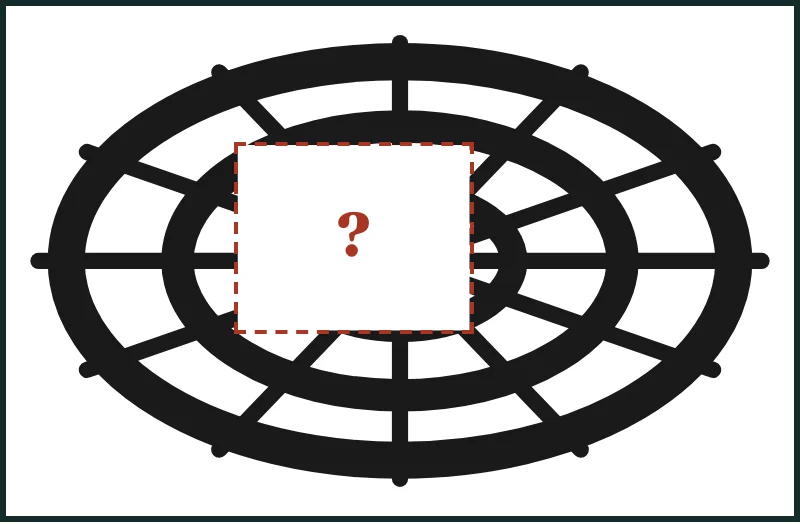
A real GateBuddy practice question.
Choose one of the five answers.
Check all four edges of the center window. The correct piece continues every orbit spoke network color boundary, corner, and line at the exact same height and angle. Similar colors are not enough if any boundary meets an edge in a different place.
Try 10 more questions free
See how easy practice can be for your child.
- Short practice sets made for kids
- Read aloud, so they can work on their own
- Extra practice where they miss
Free parent account. No credit card.
Practice preview
Let your child see the format before test day.
GateBuddy introduces the visual reasoning formats used on the NNAT® through short, age-appropriate practice with clear explanations.
- Built around the four NNAT® question types
- An explanation after every answer: what changed and what stayed the same
- Short adaptive sets plus full, timed practice tests
- A live view so parents can follow along


Real GateBuddy practice questions, one of each NNAT® question type.
What 2nd graders should expect from the NNAT®
The NNAT® asks children to solve visual problems. They look for changes in shape, color, position, rotation, sequence, and spatial relationships.
That can be very different from normal schoolwork. A child who already understands the format can spend more attention on the puzzle itself.
Elementary schools in Columbus City Schools
In most districts, a gifted-screening window applies across the district, while each school handles practical details inside that window. For Columbus families, November is the planning month, and your child’s school is the place to confirm the exact day and make-up instructions.
Columbus City Schools elementary and K-8 campuses include:
- Alpine Elementary School
- Avalon Elementary School
- Avondale Elementary School
- Beatty Park Elementary School
- Berwick Alternative Elementary
- Binns Elementary School
- Burroughs Elementary School
- Cassady Elementary School
- Cedarwood Alternative Elementary
- Clinton Elementary School
- Colerain Elementary School
- Columbus Africentric Early College PreK-12
- Columbus Spanish Immersion Academy
- Como Elementary School
- Cranbrook Elementary School
- Devonshire Elementary School
- Duxberry Park Elementary School
- Eakin Elementary School
- East Columbus Elementary School
- East Linden Elementary School
- Eastgate Elementary School
- Easthaven Elementary School
- Ecole Kenwood French Immersion
- Fairmoor Elementary School
- Forest Park Elementary School
- Gables Elementary School
- Georgian Heights Elementary School
- Hamilton STEM Academy
- Highland Elementary School
- Hubbard Elementary School
- Huy Elementary School
- Indian Springs Elementary School
- Indianola Informal K-8
- Innis Elementary School
- Leawood Elementary School
- Liberty Elementary School
- Lincoln Park Elementary School
- Lindbergh Elementary School
- Linden STEM Academy
- Livingston Elementary School
- Maize Elementary School
- North Linden Elementary School
- Northgate Intermediate School
- Northtowne Elementary School
- Oakland Park Elementary School
- Oakmont Elementary School
- Ohio Avenue Elementary School
- Olde Orchard Alternative Elementary
- Parkmoor Elementary School
- Parsons Elementary School
- Salem Elementary School
- Scottwood Elementary School
- Shady Lane Elementary School
- Siebert Elementary School
- South Mifflin STEM Academy
- Southwood Elementary School
- Starling PreK-8
- Stewart Alternative Elementary School
- Sullivant Elementary School
- Trevitt Elementary School
- Valley Forge Elementary School
- Valleyview Elementary School
- Watkins Elementary School
- Weinland Park Elementary School
- West Broad Elementary School
- West Mound Elementary School
- Westgate Elementary School
- Windsor STEM Academy
- Winterset Elementary School
- Woodcrest Elementary School
Curious how your child would do? Find out with no pressure.
Try 10 questions free nowWhat Gifted & Talented gives your child in Columbus City Schools
CCS offers a range of services, and families can choose a less intensive option than the one their child qualifies for. For elementary and middle school, the district lists:
- Gifted resource room, grades K-2: at all elementary schools, for students identified in superior cognitive ability, creative thinking, or reading.
- Self-contained gifted reading or math classes, grades 3-8: at select schools, for students identified in reading or math. The student’s enrollment moves to that building.
- Columbus Gifted Academy, grades 3-8: a full-time gifted program at one location for students identified in superior cognitive ability, or in both reading and math.
- Enrichment and differentiation in every school: an informal service without a Written Education Plan.
- Acceleration: skipping a subject or a grade when a student already knows the material.
The 2nd grade superior cognitive identification is what opens the Columbus Gifted Academy option in 3rd grade. In high school, gifted services shift to Honors, Advanced Placement, International Baccalaureate, and College Credit Plus courses, plus an online Gifted Support elective in grades 9 and 10 for students identified in superior cognitive or creative thinking ability.
Questions Columbus parents should ask
- What exact date is my child’s class taking the 2nd grade NNAT?
- What should students expect during the test session?
- What happens if my child is absent on test day?
- When will scores be sent home?
- What gifted services would my child receive at our school if identified?
- When is the referral deadline if we want our child tested again or in another area?
Short, adaptive practice your child can finish on a school night.
Start 10 free questionsHow to prepare effectively for the NNAT
Useful prep is about knowing the format, not cramming. A simple plan:
- Learn the format first. Work through a few questions of each of the four NNAT® question types together, and after each one have your child say the rule out loud: what changed and what stayed the same. Our guide to the four NNAT® question types shows each one. GateBuddy shows an explanation after every question that names the rule, and it can read instructions and explanations out loud, which helps a child who is still building reading skills or simply learns better by hearing it.
- Practice 10 to 15 minutes a day, for as long as you can. Reasoning skills build like a muscle, a little at a time. A few weeks of practice helps, but months of short, steady sessions build much more.
- Spend extra time on the weakest question type. Once you see which type your child misses most, give it a larger share of each session. GateBuddy’s practice sets do this for you: each set of five leans toward the question types your child has seen least and adjusts how hard the next questions are based on recent answers. You can also pick one question type and a level (easy, medium, or hard) to work on a weak spot.
- Take full, timed practice tests: at least two, and more is better. A full test is where your child learns pacing and how to work alone against a clock, the way test day works. Every GateBuddy plan includes eight full, timed NNAT® practice tests, so your child can take several along the way and still save the last two for the final few weeks as a dress rehearsal. While your child works on their own, GateBuddy’s Live View lets you follow along from your own phone: how many questions they have answered, the answer they just picked, and how many they have right so far. Your child gets the independence of test day, and you still see everything.
Practice teaches your child what the questions look like and ways to approach them, so test day feels familiar. Our guide to how to prepare for the NNAT® gives a simple weekly plan.
Why GateBuddy
Practice that feels like test day, built by parents who needed it.
GateBuddy started with parents preparing their own kids for the NNAT® and finding mostly printable packets and answer keys. So they built what they wished they had: short daily practice that adapts, full timed tests that feel like test day, and a way to see progress without hovering.
What your child gets:
- Five questions at a time, picked for your childEach short set adapts to your child’s recent answers and to the question types they have seen least. Ten to fifteen minutes fits on a school night.
- Explanations that teach the ruleAfter every question, your child sees what changed and what stayed the same, so the idea carries over to the next one.
- Read aloud when it helpsInstructions and explanations can be read out loud, so a child still learning to read can focus on the reasoning.
- Full, timed practice testsEight full tests with a visible timer, a question list to skip and come back, and pause and resume for real life. Take several along the way and save the last two as dress rehearsals.
- Live view for parentsFollow a practice test from your own phone: questions answered, the answer just picked, and how many are right so far. Your child works on their own, like test day.
- Focused practice when you want itPick one of the four NNAT® question types and a level (easy, medium, or hard) to work on a weak spot.
GateBuddy vs printable packets and workbooks
| Feature | Packets and workbooks | GateBuddy |
|---|---|---|
| Choosing what to practice next | The same pages for every child | Adapts to your child’s answers |
| When an answer is wrong | A letter in the answer key | An explanation of the rule |
| Timed practice | You time it yourself | Built-in timer, skip and return, pause |
| Watching progress | Grade it by hand afterward | Live view while they work |
| Format | Paper | On screen, the way many districts now give it |
Start with 10 free questions.
See how your child handles NNAT® practice questions in about ten minutes, then decide.
Frequently asked questions
Do Columbus City Schools 2nd graders take the NNAT?
Yes. Columbus City Schools says every 2nd grader takes the NNAT (Naglieri Nonverbal Ability Test) in November to screen for superior cognitive ability. No sign-up is needed.
When are Columbus City Schools gifted screening results sent home?
Columbus City Schools says whole-grade screening scores are usually sent home in February or March.
What NNAT score does Columbus list for superior cognitive ability?
Columbus City Schools lists a required NNAT score of 126 for superior cognitive ability identification. A score of 110 or higher also leads to screening for creative thinking.
Can a Columbus child in another grade be tested?
Yes. Any student in grades K-12 can be referred for gifted testing. For 2026-2027, fall referrals are accepted from the first day of school through October 31, and spring referrals from December 1 through mid-March.
How long is the NNAT?
The NNAT has 48 questions and takes about 30 minutes.
- Columbus City Schools: Gifted Identification Process
- Columbus City Schools: Areas of Identification
- Columbus City Schools: Gifted Identification & Assessments (2026-2027 timelines)
- Columbus City Schools: Gifted Services
- Columbus City Schools: schools
- GateBuddy: What is the NNAT®?
GateBuddy compiled this guide from its own research of publicly available information and is not affiliated with Columbus City Schools. The guide may contain errors or be out of date. Please confirm all details with your school or district.