The biggest confusion starts here: percent correct, percentile, and qualification are not interchangeable. A child might answer what feels like "a lot" of questions correctly and still leave a parent uncertain, because the school report often does not lead with a simple raw score. It may emphasize percentile rank, or it may fold the test into a larger identification process where one result is only part of the picture.
Percent correct is not the same as percentile
Percent correct is straightforward. It is how many questions a child answered correctly out of 48. Percentile means something different: how that performance compares to other children of the same age in the norm group. A percentile of 85 does not mean a child got 85 percent of the questions right. It means the child performed as well as or better than 85 percent of same-age peers in the comparison group.
This is one reason score conversations get confusing so quickly. Parents naturally hear a number and interpret it as classroom-style accuracy. Schools, by contrast, are often talking about where the child falls in a larger comparison group. Those are related ideas, but they are not the same one.
See the real question format in about ten minutes.
Try 10 questions freeSample question
Try an NNAT® practice question
Look across the rows and down the columns. Choose what completes both patterns.
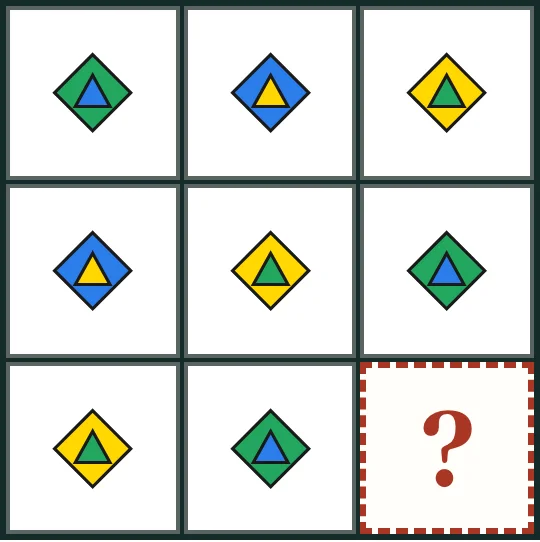
A real GateBuddy practice question.
Choose one of the five answers.
The outside and inside colors move through the same three-color cycle. Every row and column uses each outside color once, and the inside shape always uses the next color in the cycle. Continue both color patterns to get white background with large blue diamond at the center and small yellow triangle at the center.
Try 10 more questions free
See how easy practice can be for your child.
- Short practice sets made for kids
- Read aloud, so they can work on their own
- Extra practice where they miss
Free parent account. No credit card.
Age matters, not just grade
The Naglieri Nonverbal Ability Test (NNAT®) compares a child to other children close in age, not simply to everyone in the same grade. Two classmates born months apart can be compared to slightly different age bands. That can make a result feel less intuitive to families who are used to classroom grades, where every student in the room is judged by the same assignment rather than by an age-based norm group.
The school decides how the result is used
This is the part most parents miss. The NNAT® itself is standardized, but the role the score plays is local. One district may use it as a universal screener. Another may use it only after referral. One may treat it as an initial filter before looking at other measures. Another may combine it with achievement scores, teacher input, portfolios, or additional testing right away.
That means the same exact NNAT® result can matter differently in different places. A score that feels strong in one district may be only one step in a longer process somewhere else. This is why the most useful follow-up question is not "Is this a good score?" but "How does our district use this result?"
Curious how your child would do? Find out with no pressure.
Try 10 questions free nowA single result is not always the full picture
A child's score on one testing day can be shaped by more than underlying reasoning ability. Fatigue, nerves, unfamiliarity with the format, and simple pacing issues can all influence how much of a child's actual thinking shows up. That does not mean the score is meaningless. It means it should be interpreted in context, especially when a district also considers other evidence.
This matters even more when a child is very capable but new to visual reasoning tasks. If a child spends valuable seconds trying to decode an unfamiliar question format, that time does not go toward the reasoning itself. A result can reflect both ability and familiarity at once.
What to ask when the score report arrives
- What number on this report matters most for the district's identification process?
- Is there a local threshold, range, or review benchmark families should understand?
- Is this result used alone, or alongside achievement data, teacher input, portfolios, or other evidence?
- Who can explain the report in plain language if the family has questions?
- If the result is lower than hoped, is there an appeal, retesting, or later review opportunity?
Short, adaptive practice your child can finish on a school night.
Start 10 free questionsWhat a parent should take away
A score report is not just a verdict. It is one part of a broader process, and it only becomes meaningful when you understand the district's rules around it. The most grounded next step is to ask how the score is interpreted locally, what else is considered, and what happens next. That gives a parent much more clarity than trying to judge the number in isolation.
Why GateBuddy
Practice that feels like test day, built by parents who needed it.
GateBuddy started with parents preparing their own kids for the NNAT® and finding mostly printable packets and answer keys. So they built what they wished they had: short daily practice that adapts, full timed tests that feel like test day, and a way to see progress without hovering.
What your child gets:
- Five questions at a time, picked for your childEach short set adapts to your child’s recent answers and to the question types they have seen least. Ten to fifteen minutes fits on a school night.
- Explanations that teach the ruleAfter every question, your child sees what changed and what stayed the same, so the idea carries over to the next one.
- Read aloud when it helpsInstructions and explanations can be read out loud, so a child still learning to read can focus on the reasoning.
- Full, timed practice testsEight full tests with a visible timer, a question list to skip and come back, and pause and resume for real life. Take several along the way and save the last two as dress rehearsals.
- Live view for parentsFollow a practice test from your own phone: questions answered, the answer just picked, and how many are right so far. Your child works on their own, like test day.
- Focused practice when you want itPick one of the four NNAT® question types and a level (easy, medium, or hard) to work on a weak spot.
GateBuddy vs printable packets and workbooks
| Feature | Packets and workbooks | GateBuddy |
|---|---|---|
| Choosing what to practice next | The same pages for every child | Adapts to your child’s answers |
| When an answer is wrong | A letter in the answer key | An explanation of the rule |
| Timed practice | You time it yourself | Built-in timer, skip and return, pause |
| Watching progress | Grade it by hand afterward | Live view while they work |
| Format | Paper | On screen, the way many districts now give it |
Start with 10 free questions.
See how your child handles NNAT® practice questions in about ten minutes, then decide.
Frequently asked questions
Is percent correct the same as percentile on the NNAT®?
No. Percent correct is how many questions a child answered correctly. Percentile compares that performance to same-age peers in the norm group.
Can the same NNAT® result be used differently by different districts?
Yes. Districts vary in whether they use the NNAT® alone, as a screener, or alongside achievement data, teacher input, portfolios, or other measures.
What is the most important score question to ask the school?
Ask how the district uses the result locally, including whether there is a threshold, whether multiple measures are considered, and who can explain the score report.
Does one NNAT® score tell the whole story?
Usually not. A single result is one data point. Many schools look at additional evidence, and a child's unfamiliarity with the format can affect how fully their reasoning shows up on one testing day.