There is no universal GATE qualifying score. Some districts publish a percentile or standard-score benchmark, while others review the gifted-test score with additional evidence such as achievement data, teacher input, or local screening rules.
Parents often search for a simple number because the stakes feel clear: did my child qualify or not? But Gifted and Talented Education, Highly Capable, and other gifted programs are run locally. Districts choose different tests, define different benchmarks, and decide whether a score is used alone or alongside other evidence.
The first trap: percentile is not percent correct
A child can take a 48-question Naglieri Nonverbal Ability Test (NNAT®3) and receive a percentile rank rather than a classroom-style percentage. Percent correct means how many questions were answered correctly. Percentile means how that performance compares with children in the norm group. A 90th percentile score does not mean the child answered 90 percent of the questions correctly.
That distinction matters because parents naturally interpret scores like school grades. Gifted screening reports are usually norm-referenced instead. They compare a child’s performance with other students of similar age or grade, depending on the assessment and report.
Sample question
Try an NNAT® practice question
Find how the top picture changes, then apply the same change to the bottom picture.
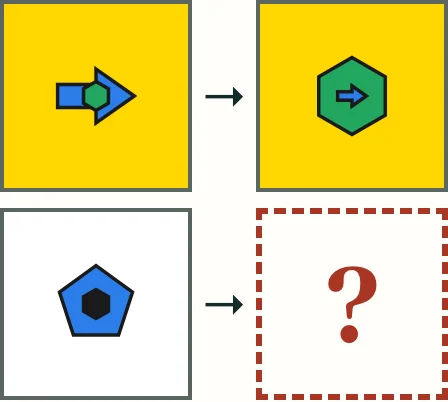
A real GateBuddy practice question.
Choose one of the five answers.
In the top row, the inside and outside shapes trade places and sizes. Each shape keeps its own color, and the background and center position stay the same. Apply that swap to the bottom picture: the pentagon moves inside, and the hexagon becomes the large outside shape.
Try 10 more questions free
See how easy practice can be for your child.
- Short practice sets made for kids
- Read aloud, so they can work on their own
- Extra practice where they miss
Free parent account. No credit card.
Is there a passing score on the GATE test?
No. A gifted test is not pass or fail, and there is no national passing score. Instead, each district sets a cutoff, usually a percentile, and decides what happens at that cutoff. In one district a score at the cutoff means a child is identified. In another it only means the child moves on to more testing or a review of other evidence.
When parents search for a GATE “passing score” or “IQ requirement,” the real answer is the district’s published rule. A few districts also accept a one-on-one IQ test. For example, Scottsdale Unified’s testing page lists a Full Scale IQ of 128 or above, and Nevada’s state rule uses the 98th percentile on a test given one-on-one.
See the real question format in about ten minutes.
Try 10 questions freeWhat the 98th, 97th, and 95th percentiles mean
A percentile rank tells you what share of the comparison group (called the norm group) your child scored as well as or better than. These are the cutoffs parents see most often:
- 98th percentile. Your child scored as well as or better than 98 out of 100 students in the norm group, which is roughly the top 2 percent. Nevada’s state rule and Washoe County’s automatic eligibility use this level.
- 97th percentile. As well as or better than 97 out of 100, roughly the top 3 percent. Arizona districts such as Scottsdale Unified and Deer Valley Unified use this level.
- 95th percentile. As well as or better than 95 out of 100, roughly the top 5 percent. Los Angeles Unified and Redondo Beach Unified use this level.
None of these is a percent correct. A child at the 95th percentile did not necessarily answer 95 percent of the questions right; they may have answered fewer, depending on how hard the test was for children their age.
NNAT3 scores: the Naglieri Ability Index and percentiles
Pearson, the publisher, says the NNAT3 reports these scores, all compared by age:
- Naglieri Ability Index (NAI). A standard score where 100 is average. Ohio districts such as Columbus and Hilliard list NNAT cutoffs like 126 on a scale where 100 is average.
- Percentile rank. Where your child falls compared with children the same age, from 1 to 99.
- Stanine. A 1 to 9 scale, where 9 is the highest band.
- Scaled scores and normal curve equivalents (NCEs). Other ways of placing the same result on a common scale.
When your district reports an NNAT3 result, ask which of these scores it uses for its cutoff, because a percentile of 95 and a standard score of 95 mean very different things.
Examples of how local cutoffs vary
District examples make the point better than theory. Moreno Valley Unified describes an NNAT3 intellectual identification benchmark of 89th percentile or a standard score of 125 or higher. Columbus City Schools lists a cognitive ability threshold of 126 or higher. Washoe County School District makes a student automatically eligible for GATE at the 98th percentile or above, and scores the 95th to 97th percentile on a state eligibility matrix.
Those are not contradictions. They are local rules. The test score is standardized, but the district decides how to use it for services, placement, review, or additional evaluation.
Curious how your child would do? Find out with no pressure.
Try 10 questions free nowPublished GATE qualifying scores by district
These are the published rules from GateBuddy’s district guides, sorted by state. The tests named are the Cognitive Abilities Test (CogAT®), the Naglieri Nonverbal Ability Test (NNAT), the Otis-Lennon School Ability Test (OLSAT), and the Naglieri General Ability Tests (NGAT). Districts that do not publish a number are left out.
| District | Test | Published rule | Guide |
|---|---|---|---|
| Deer Valley Unified, Arizona | CogAT® | 97th percentile or higher in verbal, quantitative, or nonverbal (Arizona rule) | Read guide |
| Scottsdale Unified, Arizona | CogAT® | 97th percentile or higher in one or more areas | Read guide |
| Capistrano Unified, California | NNAT | 96th percentile or higher; 92nd to 95th percentile can go to a portfolio review | Read guide |
| Glendale Unified, California | NNAT3 | 92nd percentile or higher | Read guide |
| Los Angeles Unified, California | OLSAT-8 | 95th age percentile or higher on total, verbal, or nonverbal (2024-25); total of 90 to 94 with meal code 1, 2, or 5 | Read guide |
| Moreno Valley Unified, California | NNAT3 | 89th percentile or higher, or a standard score of 125 or higher | Read guide |
| Redondo Beach Unified, California | OLSAT or NNAT3 | 95th percentile or higher on one administration; 90th to 94th can retest in the fall | Read guide |
| San Ramon Valley Unified, California | CogAT® | National age percentile rank of 98 or higher, or 97 plus a 99 in one area | Read guide |
| Turlock Unified, California | NNAT3 | Score of 110 or higher, or 100 to 109 plus multiple measures (listed as scores, not percentiles) | Read guide |
| Douglas County, Colorado | CogAT® | Roughly the top 5 percent nationally, within a body of evidence | Read guide |
| Jeffco Public Schools, Colorado | CogAT® | 95th percentile on age or grade norms, within a body of evidence | Read guide |
| Montgomery County Public Schools, Maryland | CogAT® | 2025-26, grade 2: composite at the 90th percentile alone, or 85th to 89th with reading or math scores and checklists | Read guide |
| Clark County School District, Nevada | Not named (NNAT2 in 2016) | No district cutoff published; Nevada’s rule uses the 98th percentile on a one-on-one test | Read guide |
| Washoe County School District, Nevada | NNAT3 | 98th percentile or higher is automatic; 95th to 97th is scored on a state eligibility matrix | Read guide |
| Chapel Hill-Carrboro City Schools, North Carolina | CogAT® | 90th percentile on Verbal or Quantitative-Nonverbal plus 90th percentile achievement; standard age score of 125 or higher for Intellectually Gifted | Read guide |
| Wake County Public School System, North Carolina | CogAT®, then Iowa Assessments | 85th percentile moves on to the Iowa Assessments; 95th percentile identifies by subject | Read guide |
| Columbus City Schools, Ohio | NNAT | 126 in 2nd grade for superior cognitive ability | Read guide |
| Hilliard City Schools, Ohio | NNAT3 | 126 (grades K-4) or 125 (grade 5) | Read guide |
| Olentangy Schools, Ohio | CogAT® | 128 in 2nd grade; 126 to 127 leads to more testing | Read guide |
| Northshore School District, Washington | NNAT3 or NGAT, then Iowa Assessments | 2nd grade: 85th percentile on the screener or i-Ready to move on; 95th percentile on one or more Iowa areas to qualify | Read guide |
Most districts combine these scores with other measures, such as achievement tests, teacher input, or a review team, and the rules can change from year to year. Confirm the current rule with your district before testing. For districts not listed, see gifted testing by state and district.
| Term | What it means | Parent takeaway |
|---|---|---|
| Raw score | Number of questions answered correctly. | Usually not the main number parents see on gifted reports. |
| Percentile rank | How the child compares with the norm group. | Useful for gifted screening, but it is not the same as percent correct. |
| Standard score | A scaled score that places performance on a common score distribution. | Some districts publish standard-score cutoffs instead of percentile-only cutoffs. |
| Local cutoff | The district’s benchmark for screening, review, or identification. | This is the number parents need from their own school or district. |
Why one score may not decide everything
The National Association for Gifted Children describes gifted identification as a process that can use multiple sources of evidence. In practice, that can mean an ability test, achievement scores, teacher input, portfolios, parent referral, or later review opportunities.
For families, that is good to know because it changes the conversation. Instead of treating a score as the entire story, ask how the district uses that score. Is it a gatekeeper? A screener? One part of a matrix? A reason to collect more information?
What to ask before or after testing
- Which assessment is used for gifted screening in this district?
- Is there a published percentile, standard-score, or local review benchmark?
- Does the district use the score alone or with other evidence?
- When will results be shared with families?
- If my child qualifies, what additional educational opportunities are offered in the current grade level and beyond?
- If my child does not qualify this year, when is the next retake or review opportunity?
Short, adaptive practice your child can finish on a school night.
Start 10 free questionsHow preparation fits into the score conversation
Good preparation should not promise a qualification outcome. What it can do is reduce surprise. When a child recognizes the question formats, understands how visual patterns behave, and has practiced working on screen under time pressure, more of the testing period can go toward reasoning rather than figuring out what the page is asking.
That is especially relevant for NNAT districts because the test is visual and unfamiliar to many students. The question types do not look like normal schoolwork, so format familiarity can matter even for strong learners.
Why GateBuddy
Practice that feels like test day, built by parents who needed it.
GateBuddy started with parents preparing their own kids for the NNAT® and finding mostly printable packets and answer keys. So they built what they wished they had: short daily practice that adapts, full timed tests that feel like test day, and a way to see progress without hovering.
What your child gets:
- Five questions at a time, picked for your childEach short set adapts to your child’s recent answers and to the question types they have seen least. Ten to fifteen minutes fits on a school night.
- Explanations that teach the ruleAfter every question, your child sees what changed and what stayed the same, so the idea carries over to the next one.
- Read aloud when it helpsInstructions and explanations can be read out loud, so a child still learning to read can focus on the reasoning.
- Full, timed practice testsEight full tests with a visible timer, a question list to skip and come back, and pause and resume for real life. Take several along the way and save the last two as dress rehearsals.
- Live view for parentsFollow a practice test from your own phone: questions answered, the answer just picked, and how many are right so far. Your child works on their own, like test day.
- Focused practice when you want itPick one of the four NNAT® question types and a level (easy, medium, or hard) to work on a weak spot.
GateBuddy vs printable packets and workbooks
| Feature | Packets and workbooks | GateBuddy |
|---|---|---|
| Choosing what to practice next | The same pages for every child | Adapts to your child’s answers |
| When an answer is wrong | A letter in the answer key | An explanation of the rule |
| Timed practice | You time it yourself | Built-in timer, skip and return, pause |
| Watching progress | Grade it by hand afterward | Live view while they work |
| Format | Paper | On screen, the way many districts now give it |
Start with 10 free questions.
See how your child handles NNAT® practice questions in about ten minutes, then decide.
Frequently asked questions
Is there a passing score on the GATE test?
No. Gifted tests are not pass or fail. Each district sets its own cutoff, usually a percentile such as the 95th, 97th, or 98th, and many districts combine that score with other measures.
What does the 98th percentile mean on a GATE test?
It means your child scored as well as or better than 98 out of 100 students in the norm group, roughly the top 2 percent. It does not mean 98 percent of the answers were correct.
Is there one score that qualifies a child for GATE?
No. Gifted identification rules are set locally, so the qualifying score or review benchmark depends on the district and the assessment used.
Is percentile the same as percent correct?
No. Percent correct is the share of questions answered correctly. Percentile compares a child’s performance to other children in the norm group.
Why do districts use different gifted cutoffs?
Districts decide their own identification model, including which assessment to use, which grade to screen, and whether to combine test scores with other evidence.
What should parents ask after receiving a gifted-test score?
Ask which score matters, what local benchmark applies, whether other evidence is reviewed, when results are released, and what services are available if the child qualifies.