Naglieri Nonverbal Ability Test (NNAT) Level C is the 2nd grade level, while Level D is used for 3rd and 4th grade. Both levels use visual reasoning tasks, but Level D generally asks students to track more details, compare closer answer choices, and manage harder transformations.
Pearson’s NNAT®3 materials list Level C for 2nd grade and Level D for 3rd and 4th grade. If your district screens all 2nd graders and then offers another opportunity later, the later version may use Level D. Chino Valley Unified families, for example, have heard that retakes are typically offered in 4th grade using NNAT Level D.
The structure is similar
Both Level C and Level D are built around nonverbal reasoning. Children work with shapes, colors, patterns, matrices, analogies, and spatial relationships rather than reading passages or vocabulary questions. Both levels use the same overall NNAT3 administration pattern: 48 multiple-choice questions in about 30 minutes.
| Area | Level C | Level D |
|---|---|---|
| Typical grade band | 2nd grade | 3rd and 4th grade |
| Timing | About 30 minutes | About 30 minutes |
| Question count | 48 questions | 48 questions |
| Question style | All four visual reasoning formats appear together. | The same visual reasoning foundation, usually with tighter answer choices. |
| Main challenge | Learning the full NNAT visual grammar for the first time. | Handling more complexity without slowing down. |
See the real question format in about ten minutes.
Try 10 questions freeSample question
Try an NNAT® practice question
Use the completed example to picture how the shapes outside the frame fold inward.
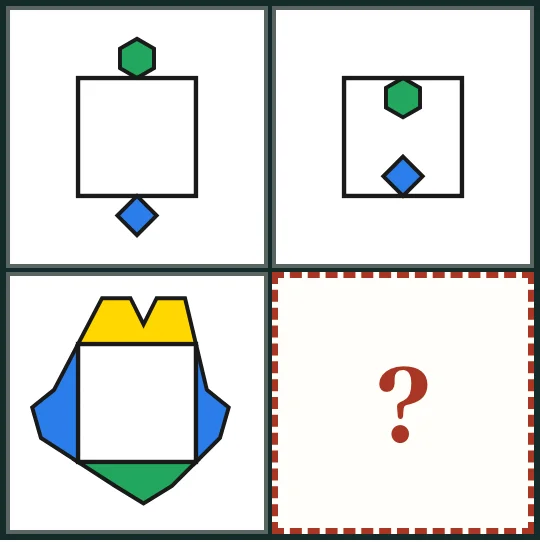
A real GateBuddy practice question.
Choose one of the five answers.
The yellow, blue, green, blue panels fold inward across their full hinge edges. They fit together around the white star-shaped space in the center. The hinge pattern sits a little below or right of center.
Try 10 more questions free
See how easy practice can be for your child.
- Short practice sets made for kids
- Read aloud, so they can work on their own
- Extra practice where they miss
Free parent account. No credit card.
What gets harder on Level D
The hard part is not a brand-new subject. It is the density of the visual reasoning. Level D questions can ask a child to track more features at once, compare more similar answer choices, and hold a mental transformation steady for longer before choosing an answer.
In Pattern Completion, distractors may match color while breaking one edge of the design. In Reasoning by Analogy, the rule may combine orientation, position, and fill. In Serial Reasoning, the row and column rules may both matter. In Spatial Visualization, a child may need to fold, rotate, or combine pieces mentally before checking the choices.
Why Level C preparation still helps later
A child who understands the four question formats is not starting from zero when the level increases. The same habits carry over: check every edge, name the transformation, test the row and column, and build the folded or combined image before looking at answer choices.
That is why good Level C practice should not be built around memorizing answers. It should teach a child how to read the visual rule. Once that skill is in place, harder Level D questions become more approachable because the child knows what kind of thinking the test is asking for.
Curious how your child would do? Find out with no pressure.
Try 10 questions free nowWhat to ask your district
- Which NNAT level will my child take this year?
- If my child does not qualify this year, when is the next retake opportunity?
- Does the later retake use Level D?
- When are results expected?
- If my child qualifies, what additional educational opportunities are offered in the current grade level and beyond?
How to practice effectively
For 2nd grade students, start with short, calm sessions that introduce the format. Five or ten focused questions a day with explanations, kept up over months, build more than occasional long sessions. Once the child understands the formats, mix in timed practice so pacing becomes familiar.
For older students preparing for Level D, the goal shifts from “what is this question asking?” to “can I hold the rule precisely while choosing among close distractors?” That is where harder practice sets, answer explanations, and full-length timed tests help most. GateBuddy offers practice on the Level D track for 3rd and 4th graders, with an explanation after every question and a choice of easy, medium, or hard sets.
Why GateBuddy
Practice that feels like test day, built by parents who needed it.
GateBuddy started with parents preparing their own kids for the NNAT® and finding mostly printable packets and answer keys. So they built what they wished they had: short daily practice that adapts, full timed tests that feel like test day, and a way to see progress without hovering.
What your child gets:
- Five questions at a time, picked for your childEach short set adapts to your child’s recent answers and to the question types they have seen least. Ten to fifteen minutes fits on a school night.
- Explanations that teach the ruleAfter every question, your child sees what changed and what stayed the same, so the idea carries over to the next one.
- Read aloud when it helpsInstructions and explanations can be read out loud, so a child still learning to read can focus on the reasoning.
- Full, timed practice testsEight full tests with a visible timer, a question list to skip and come back, and pause and resume for real life. Take several along the way and save the last two as dress rehearsals.
- Live view for parentsFollow a practice test from your own phone: questions answered, the answer just picked, and how many are right so far. Your child works on their own, like test day.
- Focused practice when you want itPick one of the four NNAT® question types and a level (easy, medium, or hard) to work on a weak spot.
GateBuddy vs printable packets and workbooks
| Feature | Packets and workbooks | GateBuddy |
|---|---|---|
| Choosing what to practice next | The same pages for every child | Adapts to your child’s answers |
| When an answer is wrong | A letter in the answer key | An explanation of the rule |
| Timed practice | You time it yourself | Built-in timer, skip and return, pause |
| Watching progress | Grade it by hand afterward | Live view while they work |
| Format | Paper | On screen, the way many districts now give it |
Start with 10 free questions.
See how your child handles NNAT® practice questions in about ten minutes, then decide.
Frequently asked questions
What grade is NNAT® Level C for?
Pearson’s NNAT®3 materials list Level C for 2nd grade.
What grade is NNAT® Level D for?
Pearson’s NNAT®3 materials list Level D for 3rd and 4th grade.
Does Level D use different question types from Level C?
Both levels can include the four NNAT® reasoning formats. Level D generally increases complexity, visual density, and distractor subtlety.
How many questions are on Level C and Level D?
NNAT®3 levels use 48 multiple-choice questions with an administration time of about 30 minutes.