Some districts start with the CogAT® Screening Form: three subtests, one from each battery, that report a single composite score. Children who meet the district’s screening score then take the rest of the test, the Post-Screener, which must be given within 30 days. Other districts give the full test to every child.
What the CogAT® Screening Form is
The publisher, Riverside Insights, offers a shorter Screening Form so districts can test a whole grade with less testing time. It uses the analogies subtest from each of the three batteries:
- Verbal: Picture Analogies at the 2nd grade level (Verbal Analogies from 3rd grade).
- Quantitative: Number Analogies.
- Nonverbal: Figure Matrices.
Sample question
Try a CogAT® practice question
Look at the bead strings. Choose what comes next.
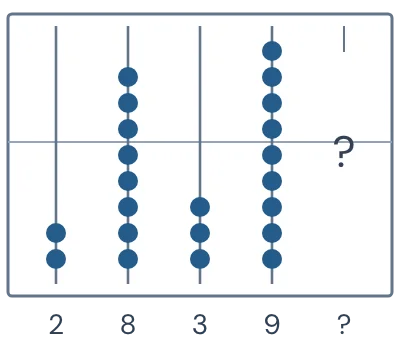
A real GateBuddy practice question.
Choose one of the four answers.
Add six, then subtract five, and repeat. Two becomes eight; Eight becomes three; Three becomes nine. Now subtract five: four.
Try 10 more questions free
See how easy practice can be for your child.
- Short practice sets made for kids
- Read aloud, so they can work on their own
- All nine CogAT® question types
Free parent account. No credit card.
What the screener reports
The Screening Form reports a composite score only. There are no separate Verbal, Quantitative, or Nonverbal scores and no ability profile. To get battery scores, a child takes the Post-Screener.
The Post-Screener and the 30-day rule
The Post-Screener is the rest of the full test, the other six subtests at the 2nd grade level. Riverside requires the two testing dates to fall within 30 days of each other for the scores to combine. If your child passes the screener, expect the next session within a few weeks, so it helps to have practiced every question type, not only the three on the screener.
| Screening Form | Full test | |
|---|---|---|
| Subtests (2nd grade) | 3 | 9 |
| Scores reported | Composite only | Verbal, Quantitative, Nonverbal, composite, ability profile |
| Who takes it | Every child, in districts that screen | Every child, or children who meet the screening score |
Districts that use a screening step
In our research, these districts describe a CogAT® screening step for 2nd graders. Each guide explains how that district runs it:
- Bellevue SD, WA
- Long Beach USD, CA
- San Diego Unified, CA
Other districts give the full CogAT® to every child. Your district’s guide says which approach it uses, and your school can confirm.
How to prepare effectively for a screening step
The screener focuses on analogies, but the full test can follow within weeks, so prepare for all nine question types from the start.
- Learn the format first, and talk through the rule after every question. Ask your child what stayed the same and what changed, so the idea carries over to the next question. GateBuddy shows an explanation after every answer, and your child can tap Listen to hear the question and the explanation read aloud.
- Practice 10 to 15 minutes a day, for as long as you can. Reasoning skills build like a muscle, a little at a time. A few weeks of practice helps, but months of short, steady sessions help more, so start as early as you can. GateBuddy’s short practice sets fit on a school night.
- Spend extra time on the weakest battery. Most children find one of the three parts harder than the others. GateBuddy’s practice adapts to your child’s answers and keeps verbal, quantitative, and nonverbal progress side by side, so you can see where to focus.
- Take full practice tests: at least two, and more is better. A full test teaches your child to keep going through nine subtests over more than one sitting, the way test day works. Every GateBuddy plan includes eight complete practice tests for the 2nd grade CogAT®, with progress saved between sections. Take several along the way, and save the last two for the final few weeks as a dress rehearsal.
GateBuddy’s free questions cover all nine question types, with an explanation after every answer.
Try 10 CogAT® questions freeQuestions to ask your school
- Which test does the district give 2nd graders: the Screening Form, the full test, or both?
- What screening score moves a child on to the full test?
- When is the follow-up test if my child passes the screener?
- Which score from the full test decides identification?
Why GateBuddy
Practice all nine CogAT® Level 8 question types in one guided program.
GateBuddy combines short adaptive practice, clear explanations after every answer, and eight complete untimed practice tests. It keeps Verbal, Quantitative, and Nonverbal progress together while showing what to practice next.
Start with 10 free CogAT® questions.
Try every Level 8 question type, then get one smart follow-up based on the answers.
Frequently asked questions
What is the CogAT® Screening Form?
A shorter version of the CogAT® with three subtests, one analogies subtest from each battery. It reports a single composite score and is used to decide who takes the rest of the test.
Which subtests are on the 2nd grade CogAT® screener?
Picture Analogies, Number Analogies, and Figure Matrices. From 3rd grade, Verbal Analogies replaces Picture Analogies.
Does the screener give battery scores?
No. The Screening Form reports a composite score only. Verbal, Quantitative, and Nonverbal scores and the ability profile come from the full test.
How soon after the screener is the Post-Screener?
Riverside requires the two testing dates to fall within 30 days of each other, so the follow-up usually comes within a few weeks.
Should we practice only the three screener question types?
No. A child who passes the screener takes the other six subtests soon after, so prepare for all nine question types from the start.