The 2nd grade Cognitive Abilities Test (CogAT®), Level 8, has nine question types, three in each of its three batteries: Verbal, Quantitative, and Nonverbal. Every question uses pictures, numbers, or shapes, so your child does not need to read. Each section below shows a real GateBuddy practice question from our free sample set, plus a simple example of our own.
The three batteries
- Verbal: Picture Analogies, Sentence Completion, and Picture Classification.
- Quantitative: Number Analogies, Number Puzzles, and Number Series.
- Nonverbal: Figure Matrices, Paper Folding, and Figure Classification.
Each battery gets its own score, and the three combine into a composite. Our guide to CogAT® scores explains how they are reported.
Verbal battery
1. Picture Analogies
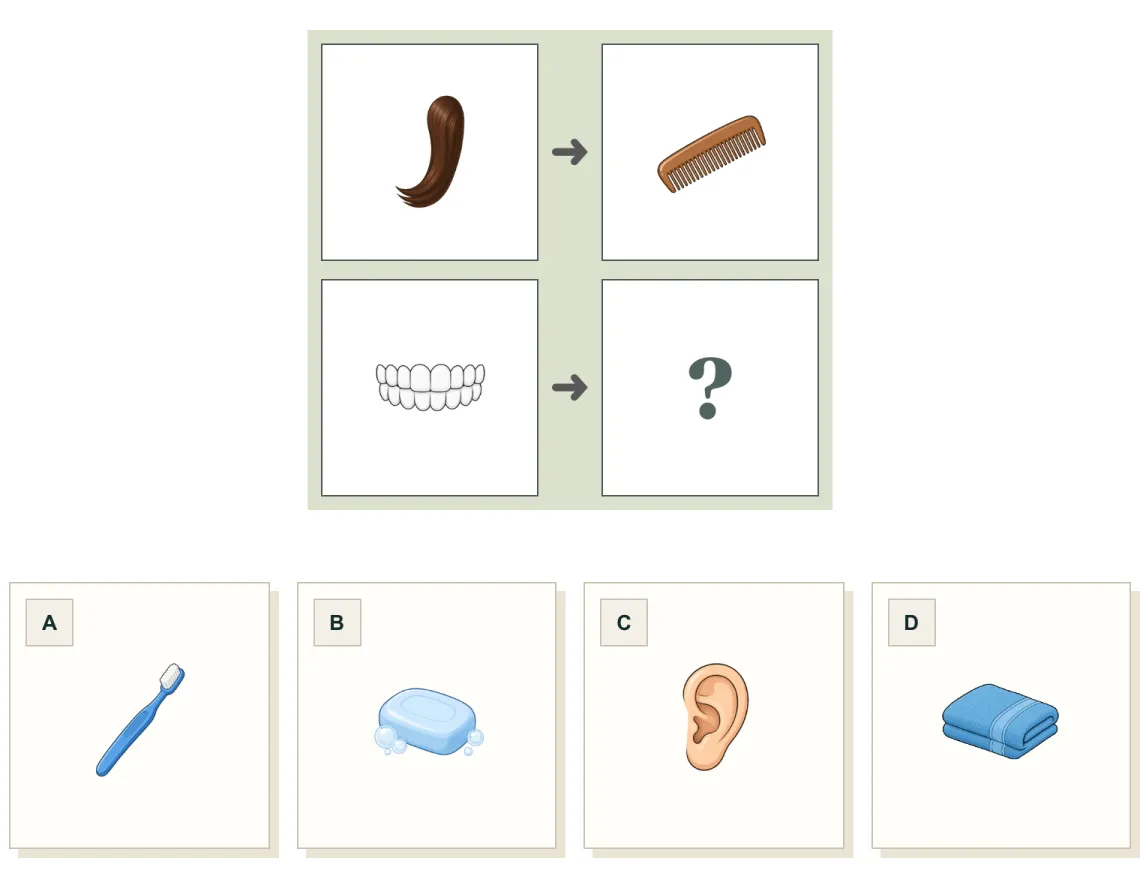
Verbal battery · 18 questions. Two pictures go together in some way. The child finds the picture that goes with a third picture in the same way.
Show the answer
A. Hair is groomed with a comb. Teeth are groomed with a toothbrush. Both rows go from what is groomed to the tool used on it.
Example: A bird goes with a nest. A bee goes with... a hive.
Common mistake: Picking something that simply goes with the third picture (a bee and a flower) instead of using the same relationship as the first pair (where it lives).
2. Sentence Completion
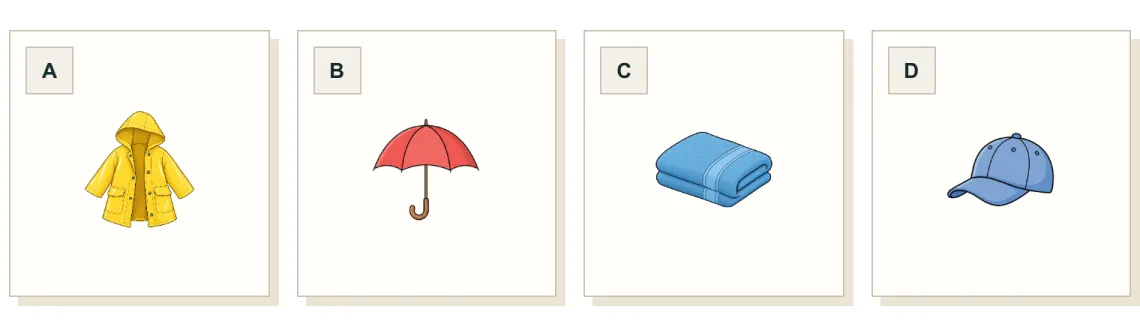
Verbal battery · 18 questions. The teacher reads a short sentence or question aloud, and the child picks the picture that fits best. It is the only subtest that uses spoken language, and some schools leave it out.
Show the answer
A. A raincoat keeps Nina dry while leaving both hands free to carry the box.
Example: “Which one would you use to cut paper?” The child picks the scissors.
Common mistake: Choosing an answer before the teacher finishes the sentence. Practice listening all the way to the end.
3. Picture Classification
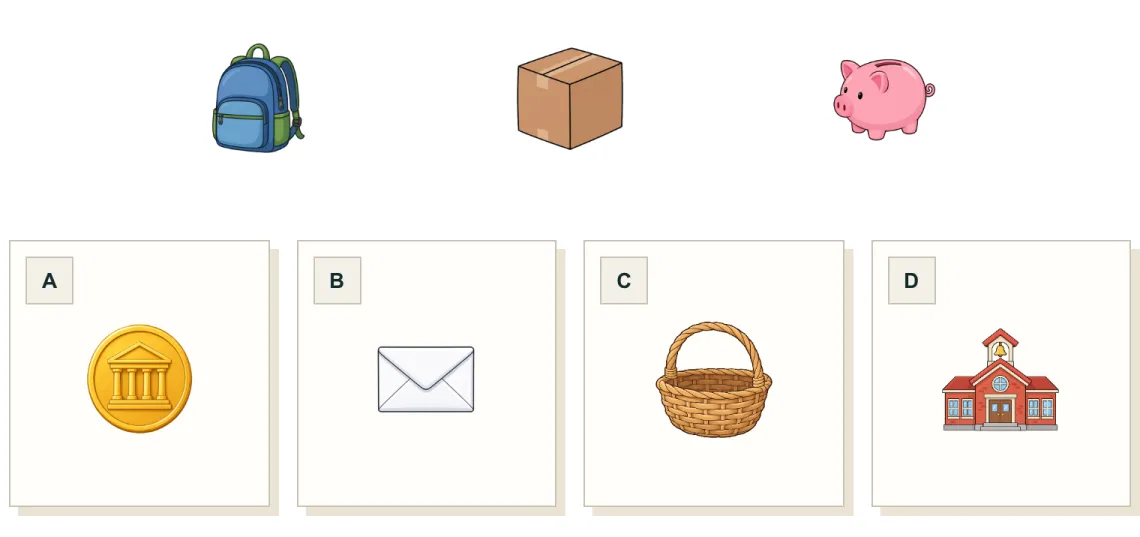
Verbal battery · 18 questions. Three pictures are alike in some way. The child picks the picture that belongs with them.
Show the answer
C. Look at what the three pictures have in common: they show containers people can carry to store things. Choose the basket, which belongs to the same group.
Example: An apple, a banana, and grapes. Which belongs: a carrot, a pear, or bread? The pear, because the group is fruit.
Common mistake: Grouping by how things look (round, the same size) instead of what they are or what they are used for.
Quantitative battery
4. Number Analogies
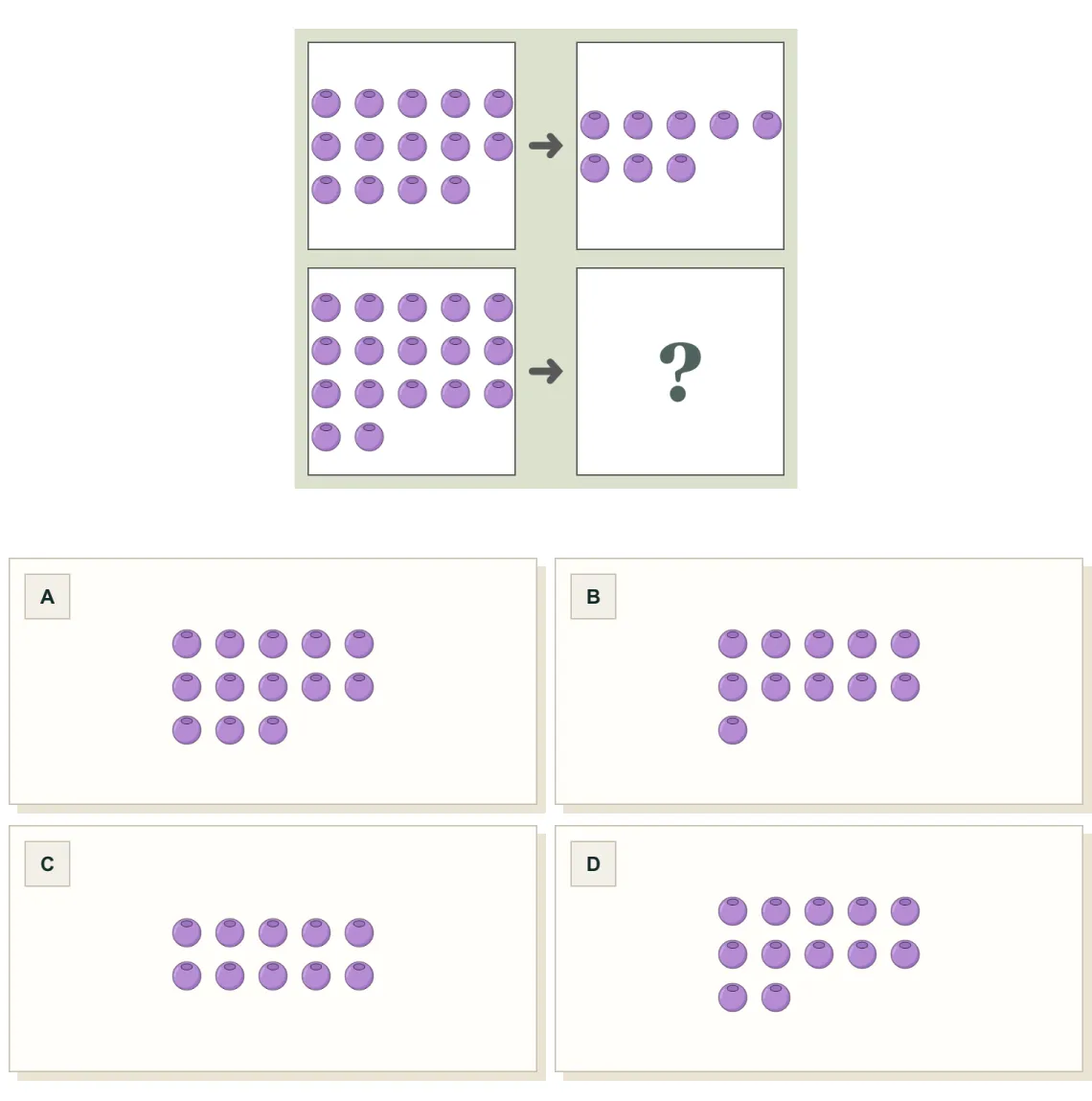
Quantitative battery · 18 questions. Pairs of pictures show a change in amount. The child applies the same change to a new picture.
Show the answer
B. The top pair shows 14 - 6 = 8. Apply the same rule: 17 - 6 = 11.
Example: Two apples become four apples. Three stars become... six stars, because the amount doubles.
Common mistake: Using a rule that works for one pair (add two) when a different rule (double it) is the one that fits every pair.
5. Number Puzzles
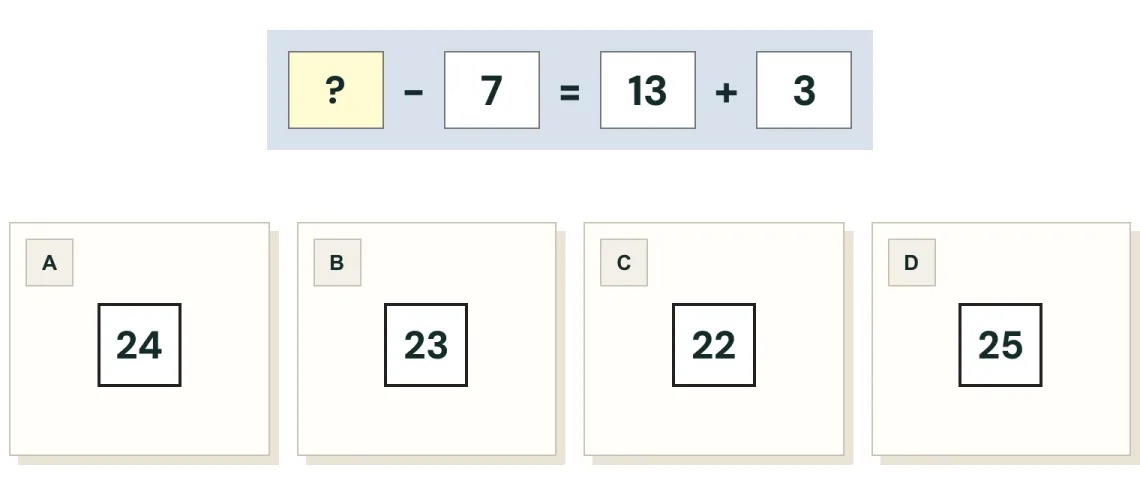
Quantitative battery · 14 questions. Short number sentences with one number missing. The child finds the number that makes both sides equal.
Show the answer
B. The right side is 13 + 3 = 16. Put 23 in the blank: 23 - 7 = 16. Both sides equal 16, so the answer is 23.
Example: ? + 2 = 5. The child picks 3, because 3 + 2 makes 5.
Common mistake: Working only one side. Figure out what one side equals first, then find the missing number on the other side.
6. Number Series
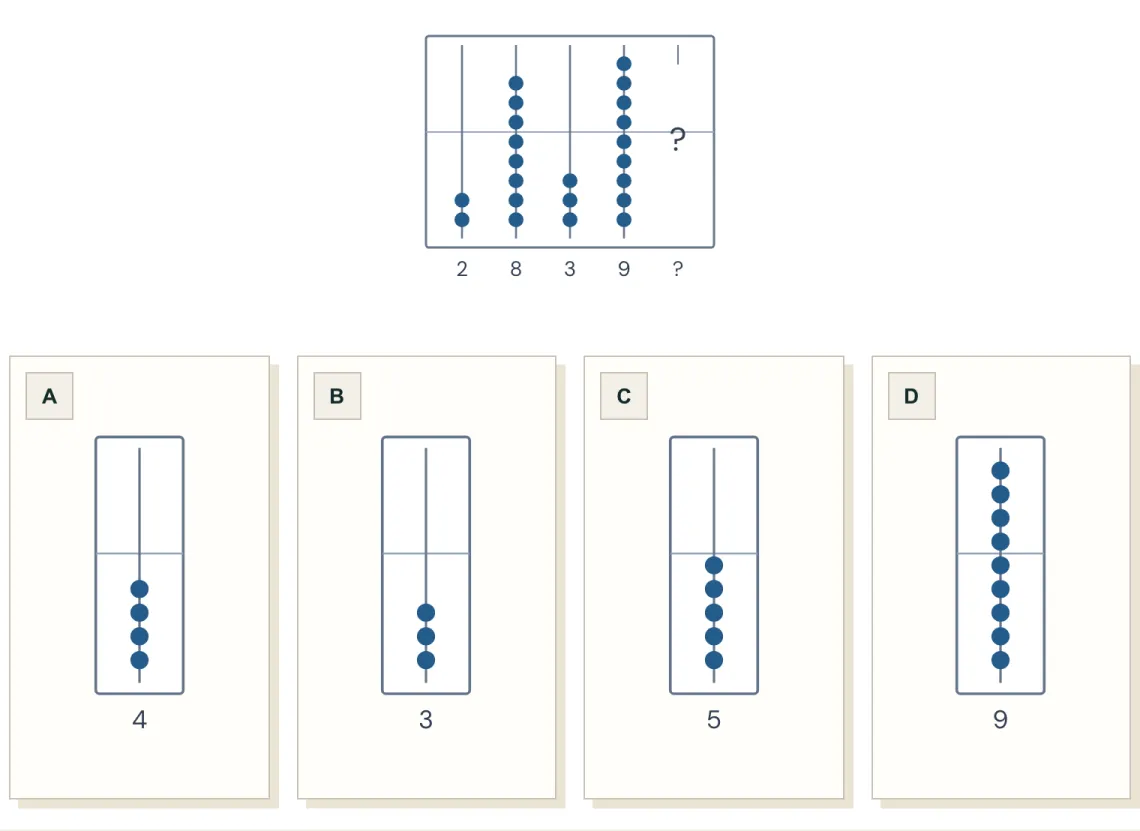
Quantitative battery · 18 questions. Beads on a string follow a pattern. The child picks what comes next.
Show the answer
A. Add six, then subtract five, and repeat. Two becomes eight; Eight becomes three; Three becomes nine. Now subtract five: four.
Example: One bead, two beads, three beads, ... four beads.
Common mistake: Looking only at the last two groups. The rule has to work for the whole string.
Nonverbal battery
7. Figure Matrices
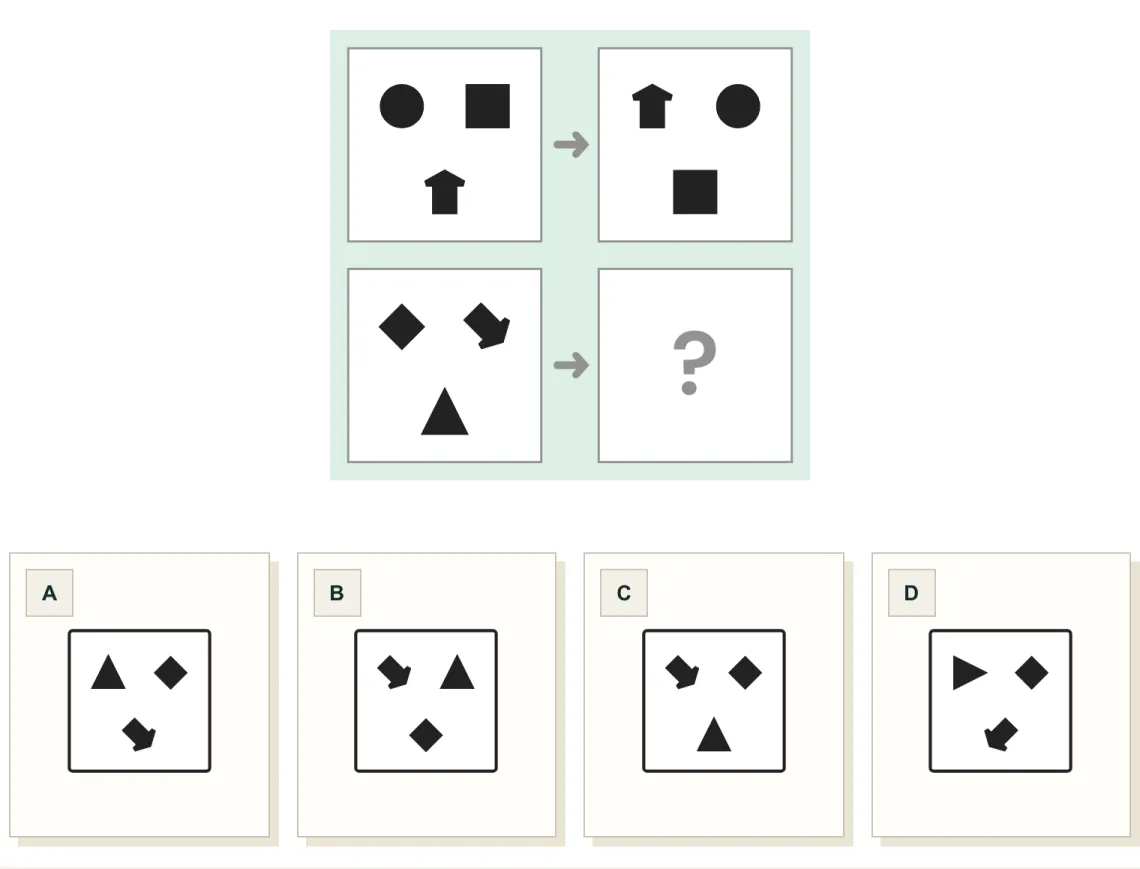
Nonverbal battery · 18 questions. A grid of shapes changes from one box to the next. The child finds the shape that completes the grid.
Show the answer
A. Each shape moves to the next position: upper left to upper right, upper right to bottom, and bottom to upper left. The individual shapes keep their sizes and directions.
Example: A small circle becomes a large circle. A small square becomes... a large square.
Common mistake: Changing two things (size and shading) when only one thing changed in the example.
8. Paper Folding
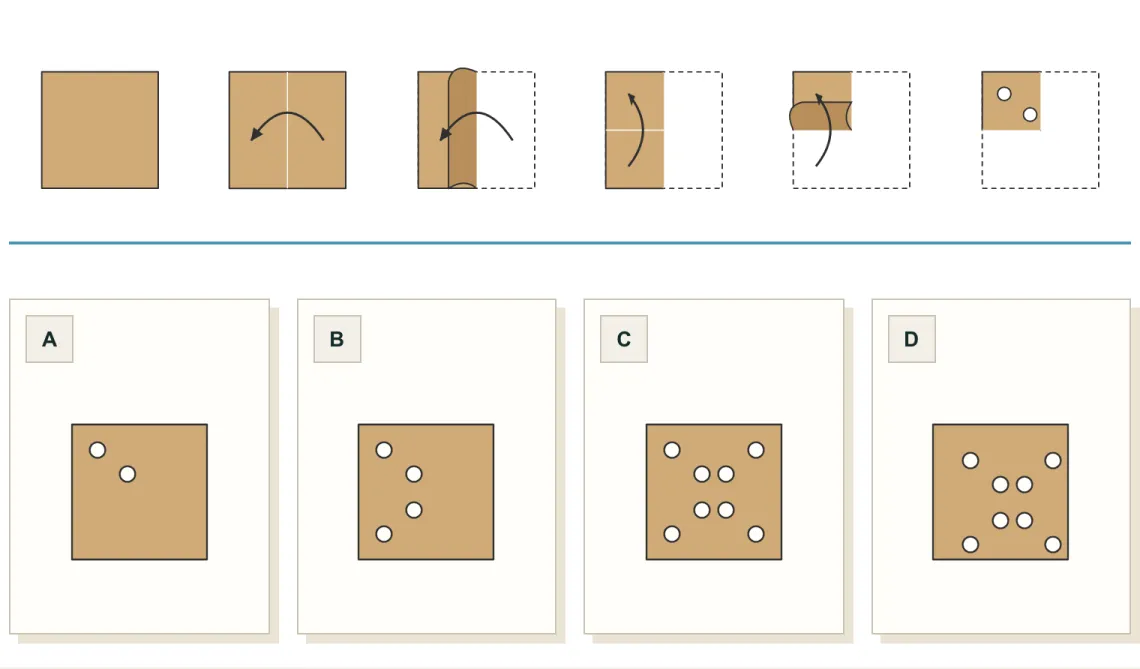
Nonverbal battery · 16 questions. A piece of paper is folded, and a hole is punched through it. The child picks what the paper looks like when it is unfolded.
Show the answer
C. Unfold in reverse order. The punched circle is reflected across each fold line, so the opened paper shows the matching circle holes.
Example: A square is folded in half and one hole is punched near the fold. Unfolded, it has two holes, mirrored across the fold line.
Common mistake: Forgetting that the hole goes through every layer, so unfolding makes more holes than were punched.
9. Figure Classification
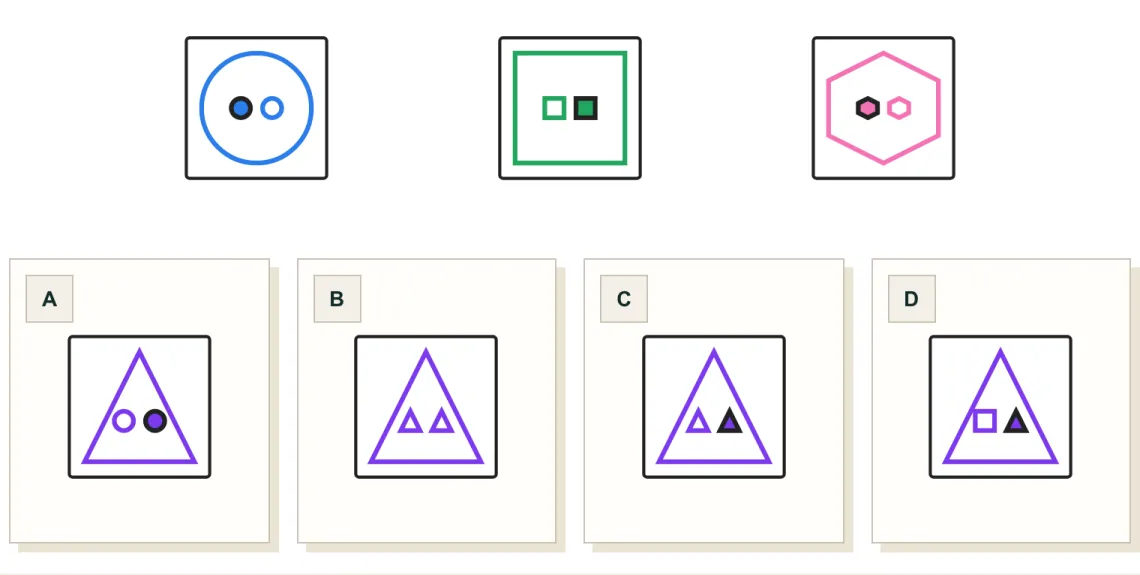
Nonverbal battery · 18 questions. Three figures are alike in some way. The child picks the figure that belongs with them.
Show the answer
C. Each large outline contains two smaller copies of its own shape. One small copy is filled and the other is an outline. The triangle containing one filled and one outline triangle follows both relationships.
Example: Three shapes that each have three sides. The answer is the only other shape with three sides.
Common mistake: Matching the shading or size, which can differ, instead of the rule all three share.
GateBuddy’s free questions cover all nine question types, with an explanation after every answer.
Try 10 CogAT® questions freeWhich question types are hardest?
It depends on the child. Paper Folding and Number Puzzles are often the least familiar at first, because nothing in everyday schoolwork looks like them. The best way to find out is to try each type and watch which ones slow your child down.
How to prepare effectively for the CogAT®
- Learn the format first, and talk through the rule after every question. Ask your child what stayed the same and what changed, so the idea carries over to the next question. GateBuddy shows an explanation after every answer, and your child can tap Listen to hear the question and the explanation read aloud.
- Practice 10 to 15 minutes a day, for as long as you can. Reasoning skills build like a muscle, a little at a time. A few weeks of practice helps, but months of short, steady sessions help more, so start as early as you can. GateBuddy’s short practice sets fit on a school night.
- Spend extra time on the weakest battery. Most children find one of the three parts harder than the others. GateBuddy’s practice adapts to your child’s answers and keeps verbal, quantitative, and nonverbal progress side by side, so you can see where to focus.
- Take full practice tests: at least two, and more is better. A full test teaches your child to keep going through nine subtests over more than one sitting, the way test day works. Every GateBuddy plan includes eight complete practice tests for the 2nd grade CogAT®, with progress saved between sections. Take several along the way, and save the last two for the final few weeks as a dress rehearsal.
Our CogAT® preparation guide turns these steps into a week-by-week plan.
Why GateBuddy
Practice all nine CogAT® Level 8 question types in one guided program.
GateBuddy combines short adaptive practice, clear explanations after every answer, and eight complete untimed practice tests. It keeps Verbal, Quantitative, and Nonverbal progress together while showing what to practice next.
Start with 10 free CogAT® questions.
Try every Level 8 question type, then get one smart follow-up based on the answers.
Frequently asked questions
How many question types are on the 2nd grade CogAT®?
Nine: Picture Analogies, Sentence Completion, and Picture Classification (Verbal); Number Analogies, Number Puzzles, and Number Series (Quantitative); and Figure Matrices, Paper Folding, and Figure Classification (Nonverbal).
How many questions does each subtest have?
Eighteen each, except Number Puzzles (14) and Paper Folding (16), for 156 questions in all at Level 8.
Does my child need to read any of the CogAT® questions?
Not in 2nd grade. Level 8 uses pictures, numbers, and shapes, and the teacher reads the directions aloud. In Sentence Completion, the teacher reads each sentence aloud too.
Is Sentence Completion always on the test?
No. It is the only subtest that uses spoken language, and some schools leave it out. Ask your school whether your child will take it.
Does GateBuddy cover all nine question types?
Yes. GateBuddy’s 2nd grade CogAT® practice covers all nine, with an explanation after every answer, adaptive practice, and eight complete practice tests.