Confirm every test date and session time with the school, keep 10 to 15 minutes of daily practice going, protect sleep and breakfast, tell your child the teacher reads the directions, and ask the school when results will arrive. Full practice tests (at least two, and more is better) belong in the weeks before test week.
What test week looks like on the 2nd grade CogAT®
Most 2nd graders take Level 8 of the CogAT®. Knowing its shape helps you plan the week:
- Three batteries. Verbal (words and pictures), Quantitative (numbers), and Nonverbal (shapes and figures).
- Nine question types. Three in each battery, such as Picture Analogies, Number Puzzles, and Paper Folding. Our guide to the nine CogAT® question types shows each one.
- Given at school, often over more than one session. Riverside Insights, the publisher, estimates about two hours of testing for Level 8, so schools usually spread it over more than one session or day.
- Directions read aloud. At the primary levels the teacher reads the directions aloud. On some online versions, recorded audio reads them through headphones instead.
Riverside lists the primary levels, including Level 8, as not timed. Your child still works through every subtest in each session, so it helps to have finished full practice tests before test week.
Sample question
Try a CogAT® practice question
Look at how the first two pictures go together. Choose the picture that goes with the third picture in the same way.
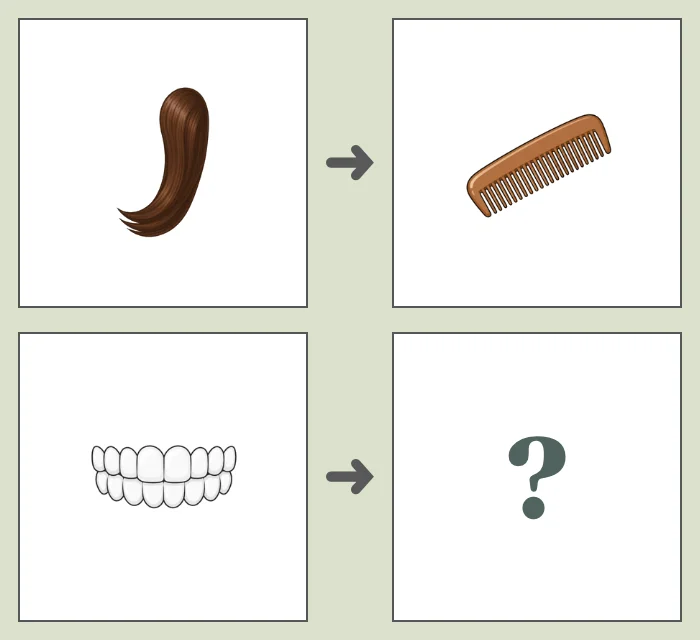
A real GateBuddy practice question.
Choose one of the four answers.
Hair is groomed with a comb. Teeth are groomed with a toothbrush. Both rows go from what is groomed to the tool used on it.
Try 10 more questions free
See how easy practice can be for your child.
- Short practice sets made for kids
- Read aloud, so they can work on their own
- All nine CogAT® question types
Free parent account. No credit card.
Before test week: finish the full practice tests
Full practice tests are the best dress rehearsal for a test that runs across several sessions. Take at least two, and more is better: take several along the way, and save the last two for the final few weeks before test week. Every GateBuddy plan includes eight complete untimed practice tests for the 2nd grade CogAT®, with progress saved between sections, so your child can finish a test over more than one sitting, the way school testing works.
Confirm the details with the school
Send one email or make one call early in the week before. These questions get a date or a clear answer back:
- What are the test dates, and what time does each session start?
- Which batteries are given on which day?
- Is the test online or on paper, and does my child need to bring headphones?
- What should my child bring, such as a snack or water bottle?
- When is the make-up date if my child is sick or absent?
- If my child has an Individualized Education Program (IEP) or a Section 504 plan, what testing accommodations apply, and who confirms them?
- When will results be sent home, and how will they arrive?
For more questions to ask, see how to ask your school about Gifted and Talented. You can also find your district’s testing window with the district lookup.
Practice during test week
Keep the daily routine going. Reasoning skills build a little at a time, and a familiar routine helps your child walk in ready:
- Practice 10 to 15 minutes every day. The same short session your child is used to fits on a school night. GateBuddy’s adaptive practice picks what to work on next from your child’s answers.
- Mix all three batteries. Touch Verbal, Quantitative, and Nonverbal questions across the week, so every question type feels familiar going in.
- Talk through the rule after every question. Ask what stayed the same and what changed. GateBuddy shows an explanation after every answer, and your child can tap Listen to hear the question and the explanation read aloud, much like the teacher reading directions on test day.
- Give a little extra time to the weakest battery. Paper Folding and Number Puzzles are often the least familiar.
- On the nights between sessions, do the usual short session. Pick familiar question types, end on a question your child gets right, and keep bedtime on schedule. Stopping early on a tired night is fine.
Sleep, breakfast, and the morning routine
- Sleep: keep a regular, on-time bedtime all week, not only the night before.
- Breakfast: serve a familiar breakfast your child usually eats on test mornings.
- Morning: lay out clothes and pack the bag the night before, and leave early enough to arrive on time without rushing.
- Health: if your child wakes up sick, call the school and ask about the make-up date rather than sending them in unwell.
How to talk to your child about the test
Keep it simple and matter of fact. Things that help a 2nd grader:
- “You will do picture, number, and shape puzzles, like the ones we practice.”
- “Your teacher will read the directions. Listen carefully, then choose your best answer.”
- “Some questions are made to be hard for everyone. If you are not sure, make your best guess and keep going.”
- “I am proud of how hard you have worked.” Praise the effort and the practice, not a result.
What to bring
Schools usually provide the test materials. Check the school’s list, and plan for:
- Headphones, if the school asks for them for an online test.
- Glasses, if your child wears them.
- A water bottle and a snack for break time, if the school allows them.
- Comfortable clothes and a layer for a cold classroom.
After the test
- Ask how it felt. Questions like “Which puzzles were fun?” tell you more than asking how many answers were right.
- Note the results date. Results timing varies by district, so ask the school when and how results will arrive and what the next step is.
- Read the score report with a guide. Our article on CogAT® scores, explained for parents walks through percentiles, stanines, and the Standard Age Score.
- Ask about next steps. Ask the school what the identification process looks like after testing, including any later testing or review steps and their dates.
Why GateBuddy
Practice all nine CogAT® Level 8 question types in one guided program.
GateBuddy combines short adaptive practice, clear explanations after every answer, and eight complete untimed practice tests. It keeps Verbal, Quantitative, and Nonverbal progress together while showing what to practice next.
Start with 10 free CogAT® questions.
Try every Level 8 question type, then get one smart follow-up based on the answers.
Frequently asked questions
Should my child keep practicing during CogAT® test week?
Yes. Keep the usual 10 to 15 minute daily sessions going through test week, with a mix of all three batteries and a talk about the rule after each question. The full practice tests belong in the weeks before, so test week is about keeping the routine steady.
How many full practice tests should my child take before the CogAT®?
At least two, and more is better. Take several along the way, and save the last two for the final few weeks as a dress rehearsal. Every GateBuddy plan includes eight complete practice tests for the 2nd grade CogAT®.
Is the 2nd grade CogAT® given in one day?
Often not. Riverside Insights estimates about two hours of testing for Level 8, and schools usually spread it over more than one session or day. Ask the school for each date and session time.
Does my child need to read on the 2nd grade CogAT®?
The directions are read aloud, by the teacher or through headphones on some online versions, and most questions use pictures, numbers, and shapes. Your child listens carefully and picks an answer.
When will we get CogAT® results?
It depends on the district. Ask the school when results will be sent home, how they will arrive, and what the next step is.
- Riverside Insights: CogAT® testing time, number of items per subtest, and completion criteria
- Riverside Insights: Shortened directions for CogAT® Levels 5/6 to 8
- Riverside Insights: Headphones and audio directions
- Riverside Insights: Introducing CogAT® Form 8
- GateBuddy: CogAT® guide for parents and district research