Key dates
- Test
- CogAT® (online)
- Grades tested
- 2 (universal)
- 2026-27 window
- Not yet posted by the districtLast published pattern: the 2nd grade CogAT® was first given in spring 2022
- What parents need to do
- None for the 2nd grade screen; watch for the letter before the window; AG Referral Form for other grades
- CogAT® level for this grade
- Level 8 for 2nd grade (the usual level; a district can give a different one, so ask your school)
From the district’s published information. Dates can change, so confirm with your school.
Guilford County Schools, which serves Greensboro, High Point, and the rest of Guilford County, North Carolina, runs its gifted program through the Academically Gifted (AG) Department. North Carolina’s state term is AIG, Academically or Intellectually Gifted. The department serves more than 12,000 advanced students in kindergarten through 12th grade.
GCS does not formally identify students for gifted services until 2nd grade. That makes the 2nd grade CogAT® the first big step for most families, and services start in the fall of 3rd grade.
Video · 5 min
What Is the CogAT® Level 8? A Parent's Guide to the 2nd Grade Gifted Test
From the GateBuddy YouTube channel. Watch the video with transcript.
What AIG identification gives your child in Guilford County
- Pull-out enrichment in elementary school: starting in the fall of 3rd grade, students identified in math or reading get 60 to 90 minutes a week of enrichment for each area, at least 60 minutes of it as pull-out. Students identified as Intellectually Gifted get 40 to 60 minutes a week of pull-out enrichment.
- The Very Strong (VS) Program: a full-time, separate gifted program for grades 4 to 8 at The Academy at Lincoln, with advanced instruction in math, reading, science, and social studies. 2nd graders with a CogAT® composite at the 92nd percentile or higher are screened for it.
- Middle and high school options: advanced academic courses in middle school, and Advanced Placement (AP), International Baccalaureate (IB), and early college choices in high school.
Sample question
Try a CogAT® practice question
Look at the bead strings. Choose what comes next.
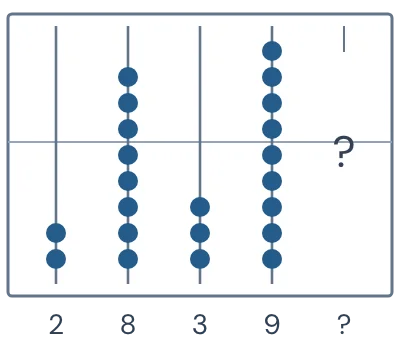
A real GateBuddy practice question.
Choose one of the four answers.
Add six, then subtract five, and repeat. Two becomes eight; Eight becomes three; Three becomes nine. Now subtract five: four.
Try 10 more questions free
See how easy practice can be for your child.
- Short practice sets made for kids
- Read aloud, so they can work on their own
- All nine CogAT® question types
Free parent account. No credit card.
How the 2nd grade screen works
- Every 2nd grader takes the CogAT®. No referral is needed. The test is given online. GCS planned to switch to an audio-led, self-paced format starting in fall 2025, with instructions available in eight languages besides English. The AIG plan describes the 2nd grade CogAT® as pictorial and untimed.
- Seven scores are checked. The district looks at the composite (verbal, quantitative, and nonverbal together), three partial composites, and the three single batteries. For everything except the full composite, it uses the higher of the national score and a local score that compares students within GCS.
- The 70th percentile opens the next step. A student at the 70th percentile or higher on any one of those seven scores takes the Iowa achievement tests in math and reading.
- The school team decides. After the CogAT® and Iowa scores come in, the school’s Team for Academically Gifted reviews them against the district criteria below.
A few students do not have to test: a child with an individual IQ score from the past 36 months, students with a severe cognitive disability, and English learners with minimal English proficiency (who may still choose to take it). A parent can also ask to waive the screen.
| Test basics | What Guilford County parents should know |
|---|---|
| Test | Cognitive Abilities Test (CogAT®), online |
| Who takes it | Every 2nd grader (universal screen) |
| 2026-27 window | Not published yet; a letter goes home before the window |
| Next step | Iowa math and reading tests for any CogAT® score at the 70th percentile or higher |
| VS Program screen | CogAT® composite at the 92nd percentile or higher |
| Services start | Fall of 3rd grade |
| Contact | Your school’s AG teacher, or aig@gcsnc.com |
How Guilford County decides who is identified
The GCS Academically Gifted page lists these criteria for students whose achievement scores come from a nationally normed test such as the Iowa, which is what 2nd graders take. Aptitude here means the CogAT®.
- Intellectually Gifted (IG): a composite aptitude score at the 98th percentile or higher.
- Academically Gifted in math, reading, or both (AM, AR, AG): the 90th percentile or higher in that subject, or the 85th to 89th percentile plus an accepted performance task.
- Academically and Intellectually Gifted (AI), pathway 1: an aptitude composite or partial composite at the 90th percentile or higher, plus the 90th percentile in both math and reading. A student at the 90th in one subject and the 85th to 89th in the other can qualify with an accepted performance task.
- Academically and Intellectually Gifted (AI), pathway 2: a composite at the 98th percentile or higher, plus the 90th percentile in math or reading (or the 85th to 89th with an accepted performance task).
The CogAT® compares each child with children the same age. See CogAT® scores, explained for parents for what composites, partial composites, and percentiles mean.
Other ways in after 2nd grade
- Yearly state test review: in grades 3 to 8, GCS reviews End-of-Grade (EOG) results each year without a referral. A Level 5 in math or reading can lead to identification in that subject.
- A second aptitude chance: students in grades 3 to 5 who score Level 5 on both the reading and math EOG but have not met the aptitude criteria take the Naglieri Nonverbal Ability Test, Third Edition (NNAT3), at the start of the next school year.
- Referral: school staff, a parent, or a community member can refer a student in any grade with the AG Referral Form, available from the school’s AG teacher.
- Transfers: students already identified as AIG in another North Carolina district keep that identification in GCS.
Questions Guilford County parents should ask
- What are the dates of this year’s 2nd grade CogAT® window at our school?
- When will we get the CogAT® results, and in what format?
- If my child scores at the 70th percentile or higher, when will the Iowa tests be given?
- When does the Team for Academically Gifted meet to review 2nd grade scores?
- When will we be told whether my child is identified, and in which area?
- When does the Grade 2 Nurture program meet in my child’s class?
Our broader questions to ask your school guide can help you plan one clear conversation with your school’s AG teacher.
How to prepare effectively for the CogAT®
- Learn the format. Go through the three parts of the Cognitive Abilities Test (CogAT®): verbal, quantitative, and nonverbal, and after every question talk through the rule: what changed and what stayed the same, not just which answer is right. GateBuddy shows an explanation after every answer, and Listen reads the question and explanation aloud.
- Practice 10 to 15 minutes a day, for as long as you can. Reasoning skills build like a muscle, a little at a time. A few weeks of practice helps, but months of short, steady sessions build much more.
- Spend extra time on the weakest type. Most children find one or two question types harder. Focus there once the basics feel familiar. GateBuddy’s adaptive practice points your child toward what to practice next.
- Take full practice tests: at least two, and more is better. A full test is where your child learns to keep going through a long sitting and work alone, the way test day works. Take several along the way, and save the last two for the final few weeks as a dress rehearsal. GateBuddy includes eight complete untimed CogAT® practice tests, with progress saved between sections.
Practice teaches your child what the questions look like and gives them ways to approach and think through them, so test day feels familiar instead of surprising.
Guilford County’s test is given to 2nd graders, which matches GateBuddy’s CogAT® Level 8 practice. Because the 2026-27 dates are not posted yet, starting now gives your child the most time to build skills before the window.
Why GateBuddy
Practice all nine CogAT® Level 8 question types in one guided program.
GateBuddy combines short adaptive practice, clear explanations after every answer, and eight complete untimed practice tests. It keeps Verbal, Quantitative, and Nonverbal progress together while showing what to practice next.
Start with 10 free CogAT® questions.
Try every Level 8 question type, then get one smart follow-up based on the answers.
Frequently asked questions
Does Guilford County Schools use the CogAT®?
Yes. Every Guilford County Schools 2nd grader takes the Cognitive Abilities Test (CogAT®) as the district’s universal screen for Academically or Intellectually Gifted (AIG) services. It is given online.
When is the Guilford County 2nd grade CogAT® for 2026-27?
GCS has not posted its 2026-27 dates. The test moved to 2nd grade starting in spring 2022, and a letter goes home to every 2nd grade family before the screening window. Ask your school’s AG teacher for the exact dates.
What CogAT® score leads to the next step in Guilford County?
A score at the 70th percentile or higher on any of seven CogAT® scores (the composite, three partial composites, or the verbal, quantitative, or nonverbal battery) leads to the Iowa achievement tests in math and reading. A composite at the 92nd percentile or higher also leads to screening for the Very Strong (VS) Program.
What score qualifies for AIG in Guilford County?
Intellectually Gifted requires a composite aptitude score at the 98th percentile or higher. Academically and Intellectually Gifted requires an aptitude score at the 90th percentile or higher plus the 90th percentile in math and reading, or a 98th percentile composite plus the 90th percentile in math or reading. Performance tasks can help students in the 85th to 89th percentile range.
When do AIG services start in Guilford County Schools?
Pull-out enrichment starts in the fall of 3rd grade for students identified in 2nd grade. Students in grades K to 2 can get consultative and Talent Development services before then.
Does GateBuddy offer CogAT® practice for Guilford County families?
Yes. GateBuddy offers CogAT® Level 8 practice for 2nd grade, with all nine question types, adaptive practice, clear explanations, and eight complete untimed practice tests.
- Guilford County Schools: Academically Gifted (criteria, VS Program, contacts)
- Guilford County Schools: 2025-2028 AIG Plan (Grade 2 universal screening, Iowa follow-up, exceptions)
- Guilford County Schools: AIG Plan 2025-2028 Information Session, Frequently Asked Questions
- Guilford County Schools: AIG Plan 2025-2028 Information Session slides
- North Carolina General Statutes Article 9B: Academically or Intellectually Gifted Students (as linked by Guilford County Schools)
GateBuddy compiled this guide from its own research of publicly available information and is not affiliated with Guilford County Schools. The guide may contain errors or be out of date. Please confirm all details with your school or district.